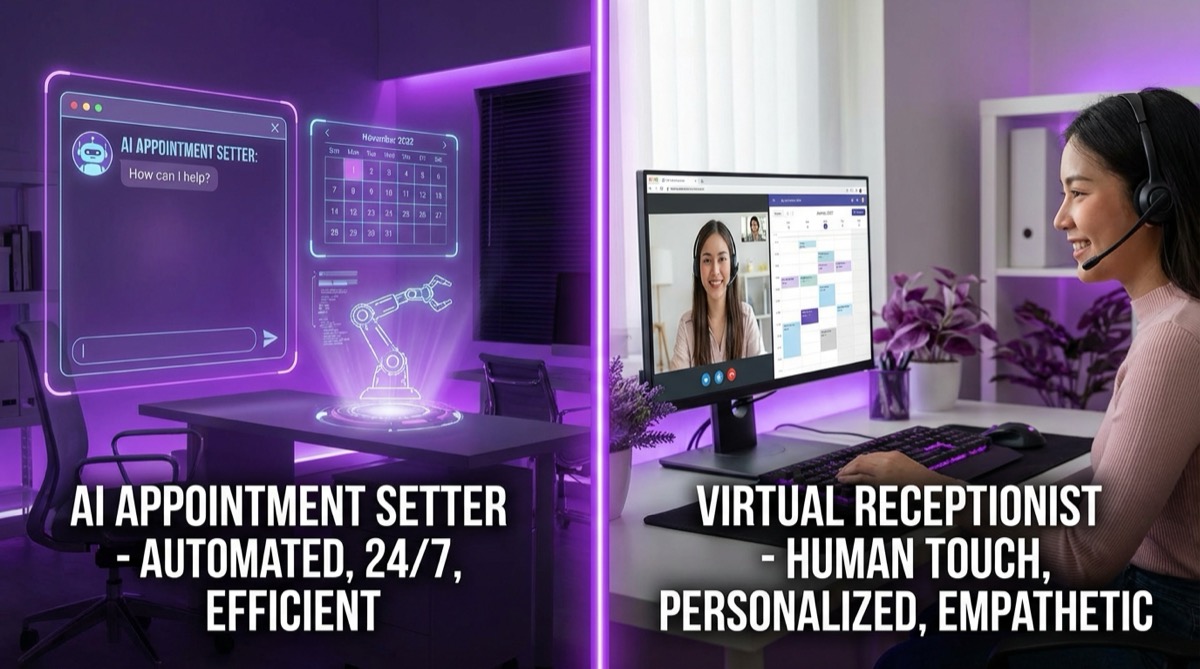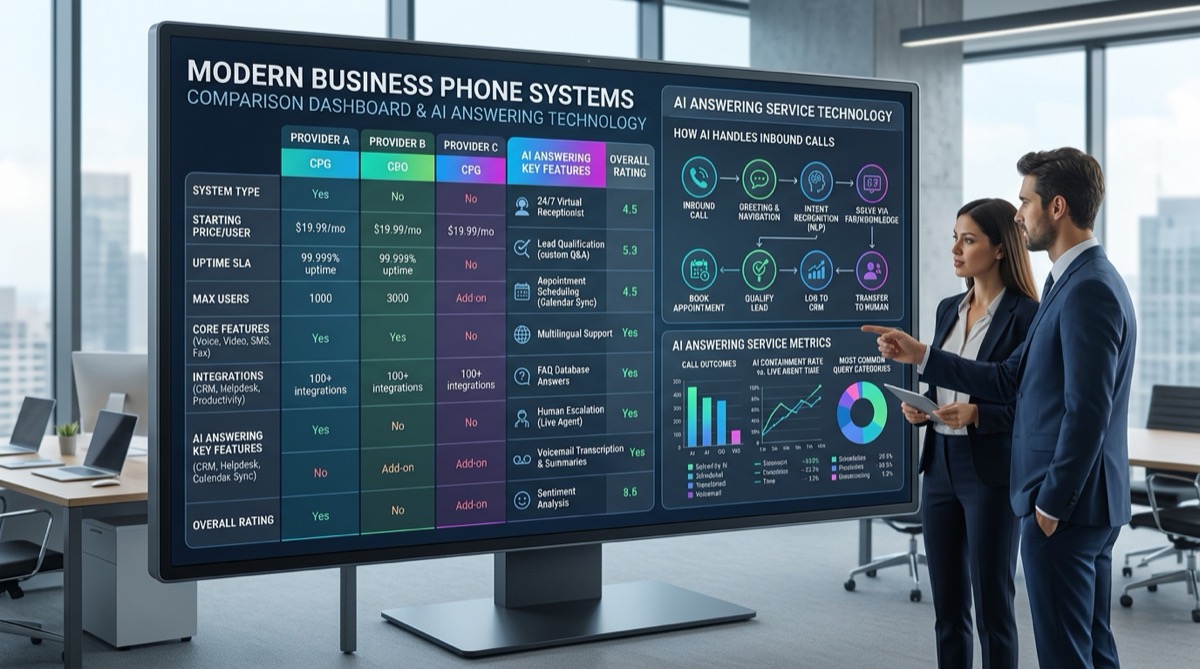
Traditional answering services cost small businesses between $200 and $1,500 per month, charge per-call fees on top, and still cannot book appointments, qualify leads, or integrate with your CRM. AI answering services have changed the economics entirely. A 2025 survey by Clutch found that 43% of small businesses that switched from traditional answering services to AI reported higher customer satisfaction scores, while spending 40% to 70% less per month.
The best AI answering services for small business in 2026 range from AI voicemail transcription at the low end to full appointment setting that qualifies the lead and books the job. Speed is what separates them: the probability of converting a lead drops 80% once you take longer than 5 minutes to respond. But "AI answering service" covers a wide range of products. Some are glorified voicemail systems with AI transcription. Others are full appointment-setting platforms that qualify leads, check calendar availability, and book meetings during the call. This guide evaluates the ten most relevant options for small businesses in 2026 and identifies which type of AI answering service fits your specific needs.
Quick picks (June 2026):
Best overall for booking appointments: CallSetter AI (done-for-you, from $497/mo). Best hybrid human + AI: Smith.ai. Best budget option: My AI Front Desk ($65/mo). Best after-hours only: Dialzara ($29/mo). Full reasoning on each below.
What Makes an AI Answering Service Worth Paying For
Before comparing specific services, it helps to understand the five capabilities that separate an AI answering service that generates revenue from one that just answers phones.
Appointment booking during the call. The single most valuable capability. If the AI can check your real-time availability and book a confirmed appointment while the caller is still on the line, your booking rate will be dramatically higher than "we'll have someone call you back." Data from speed-to-lead research shows that the probability of converting a lead drops 80% if you do not respond within 5 minutes.
Lead qualification. Not every caller is a good fit. An effective AI answering service asks the right questions to determine service area, budget range, urgency, and whether the caller matches your ideal customer profile. This saves your team from spending 15 minutes on a call with someone who lives outside your service area.
CRM integration. Call data needs to flow into your existing systems automatically. If your team has to manually review AI call logs and type information into your CRM, you have traded one bottleneck for another. The best services push data directly to ServiceTitan, Housecall Pro, GoHighLevel, HubSpot, or whatever platform your business runs on.
Natural conversation quality. Callers should not realize they are talking to AI. If your answering service sounds robotic, confuses callers, or cannot handle basic follow-up questions, it creates a worse impression than voicemail. Ask for sample recordings of real production calls before signing up.
Intelligent escalation. Some calls need a human. Emergencies, upset customers, complex technical questions, and sensitive situations should route to your team with full context. The AI should handle 80% or more of routine calls, and seamlessly transfer the rest.
The 10 Best AI Answering Services for Small Business
1. CallSetter AI (Best for Appointment Booking)
CallSetter AI is a done-for-you AI answering and appointment setting service built for businesses that depend on inbound calls becoming booked appointments. Unlike self-service platforms, CallSetter's team writes your scripts, configures your CRM integrations, and optimizes your call handling based on real performance data. We handle the whole launch for you.
The core differentiator is appointment economics. Every feature is designed around one outcome: converting more inbound calls into confirmed bookings. The AI answers in under 60 seconds, qualifies the caller using industry-specific criteria, checks real-time availability, books the appointment, and sends confirmation messages. All while syncing the lead data to your CRM.
For home service businesses, dental practices, real estate agencies, and healthcare providers, this focus translates to measurable revenue recovery. The ROI analysis shows that most businesses recoup the monthly cost within the first two weeks through recovered missed-call revenue alone.
- Pricing: Flat monthly fee starting at $297/month. No per-call or per-minute charges.
- Setup: Done for you, end to end.
- Best for: Any appointment-based business that needs 24/7 inbound call answering with live booking.
- Key integrations: ServiceTitan, Housecall Pro, Jobber, GoHighLevel, HubSpot, Google Calendar, Calendly.
An answering service that cannot book appointments is just expensive voicemail. CallSetter AI books the appointment during the call, while the lead is engaged and ready to commit.
2. Smith.ai (Best Hybrid Human/AI Service)
Smith.ai uses a combination of AI and human receptionists. Routine calls are handled by AI, and complex or sensitive conversations are routed to a live person. This hybrid approach works well for law firms, financial advisors, and healthcare practices where certain calls require human judgment.
The downside is cost. Smith.ai charges per call, and those charges add up quickly. A business handling 200 calls per month can expect to pay significantly more than flat-rate alternatives. For high-volume businesses, the per-call model becomes prohibitively expensive compared to flat monthly pricing.
- Pricing: Per-call plans starting around $292.50/month for a limited call count. Overage charges apply.
- Best for: Law firms and financial services with complex intake needs.
- Limitation: Expensive at scale. Not cost-effective for businesses with high call volumes.
3. Ruby Receptionists (Best Traditional + AI Blend)
Ruby has been in the answering service business since 2003 and has layered AI capabilities onto its existing human receptionist service. Calls are answered by a combination of AI and US-based receptionists. Ruby's strength is in providing a polished, professional phone experience with the reliability of a well-established company.
Ruby's weakness is that it still operates primarily as a message-taking and call-routing service. Appointment booking capability exists but is not as deeply integrated as purpose-built AI appointment setters. Pricing is also on the higher end for the category.
- Pricing: Monthly plans starting around $245/month for a limited number of receptionist minutes.
- Best for: Professional services firms that prioritize polished phone presence over automation depth.
- Limitation: Per-minute pricing model. Limited AI-native appointment booking.
4. Goodcall (Best for Simple Setups)
Goodcall provides a straightforward AI answering service designed for small businesses that want something better than voicemail without the complexity of a full platform. Setup is quick. The AI answers calls, takes messages, provides basic business information, and can handle simple routing.
- Pricing: Monthly plans at an accessible price point for small businesses.
- Best for: Very small businesses needing basic after-hours call answering.
- Limitation: Limited appointment booking, fewer CRM integrations, less conversation sophistication.
Need More Than Just Answering? Need Booking.
CallSetter AI answers your calls, qualifies leads, and books appointments directly into your calendar. Flat monthly pricing, done for you.
Book a Demo5. My AI Front Desk (Best Budget Option)
My AI Front Desk targets small businesses and solo practitioners looking for AI phone answering at the lowest possible price point. It handles basic call answering, provides information about your business, and offers simple scheduling capabilities. The platform is designed for simplicity, not depth.
- Pricing: Lower monthly plans designed for budget-conscious businesses.
- Best for: Solo practitioners and startups testing AI phone answering for the first time.
- Limitation: Basic feature set. Limited customization and integration options.
6. Numa (Best for Restaurants and Retail)
Numa focuses on small businesses that receive high volumes of repetitive calls: restaurants, retail stores, and local service shops. The AI handles common questions (hours, location, menu items, availability) and can route more complex calls to staff. Numa's research has been widely cited, including their finding that 62% of small business calls go unanswered.
- Pricing: Tiered monthly plans based on business type and call volume.
- Best for: Restaurants, retail, and businesses with high volumes of repetitive FAQ-type calls.
- Limitation: Not designed for appointment-heavy businesses. Limited booking capability.
7. Dialzara (Best for After-Hours Only)
Dialzara positions itself as an AI answering service specifically for after-hours coverage. The concept is that your team handles calls during business hours, and Dialzara's AI takes over when you close. This makes it a supplement to your existing phone operations rather than a replacement.
- Pricing: Monthly plans focused on after-hours use cases.
- Best for: Businesses that already have phone coverage during business hours but need after-hours support.
- Limitation: Limited to after-hours. Does not solve the daytime missed-call problem.
8. Lindy (Best for Multi-Channel Automation)
Lindy is a broader AI assistant platform that includes phone answering as one capability among many. If you need AI handling email, scheduling, task management, and phone calls, Lindy offers a single platform approach. The trade-off is that no single capability is as deep as a specialized tool.
- Pricing: Tiered monthly plans based on usage across all channels.
- Best for: Businesses wanting multi-channel AI automation in one platform.
- Limitation: Phone answering is not as sophisticated as dedicated voice AI platforms.
9. AnswerConnect (Best Traditional Service with AI Features)
AnswerConnect is a traditional 24/7 answering service that has added AI features to its existing human receptionist workforce. The AI pre-screens and routes calls, handles simple inquiries, and escalates to human operators when needed. It is a well-established company with decades of experience in phone answering.
- Pricing: Monthly plans with per-minute billing. Higher cost than pure AI solutions.
- Best for: Businesses that want the safety net of human operators with AI efficiency.
- Limitation: Per-minute pricing model is more expensive than flat-rate AI-only services.
10. Synthflow (Best for DIY Configuration)
Synthflow provides a no-code platform for building AI phone agents. It is not technically an answering "service" because you build and manage the agent yourself using a visual interface. However, for tech-savvy business owners who want control over every aspect of their AI phone experience, it offers significant flexibility.
- Pricing: Tiered monthly plans with per-minute usage charges.
- Best for: Tech-savvy business owners who want DIY control over their AI phone agent.
- Limitation: You manage everything: scripts, optimization, troubleshooting. No account manager.
Comparison Table: AI Answering Services at a Glance
| Service | Appointment Booking | Pricing Model | Best For |
|---|---|---|---|
| CallSetter AI | Full live booking | Flat monthly | Appointment-based businesses |
| Smith.ai | Basic scheduling | Per-call | Law firms, sensitive calls |
| Ruby | Limited | Per-minute | Professional services |
| Goodcall | Basic | Monthly | Simple call answering |
| My AI Front Desk | Basic scheduling | Monthly | Budget businesses |
| Numa | None | Tiered monthly | Restaurants, retail |
| Dialzara | Limited | Monthly | After-hours only |
| Lindy | Basic | Tiered monthly | Multi-channel automation |
| AnswerConnect | Human-assisted | Per-minute | Traditional + AI blend |
| Synthflow | Configurable | Tiered + per-minute | DIY builders |
Cost Comparison: What You Actually Pay
The biggest hidden cost in AI answering services is the pricing model. A service that looks affordable at low volume can become shockingly expensive as your call count grows. Here is what 200 calls per month actually costs with each pricing model, based on publicly available pricing data.
Monthly Cost at 200 Calls (Estimated)
The flat monthly model becomes dramatically more cost-effective at higher volumes. If you handle 400+ calls per month, per-call and per-minute services can cost 3 to 5 times more than a flat-rate alternative. Our complete cost analysis breaks this down in detail across multiple industries.
How to Choose the Right AI Answering Service
Start with your primary need. If you need appointment booking as the core capability, choose a service built around that function. If you need general call answering and message-taking, a simpler service may be sufficient. If your calls frequently involve complex or sensitive situations, consider a hybrid human/AI option.
Then evaluate cost at your actual volume. Calculate what you will pay at 100, 200, and 500 calls per month. Per-call and per-minute models look cheaper at low volume but cross over quickly. For any business handling more than 150 calls per month, flat monthly pricing almost always wins.
Finally, test the product. Ask for sample call recordings. Call the demo number yourself. Have a friend call pretending to be a customer. The gap between marketing claims and real-world call quality is significant across this market. An AI answering service that sounds robotic, gets confused by simple questions, or fails to book an appointment when asked will cost you more in lost customers than it saves in answering costs.