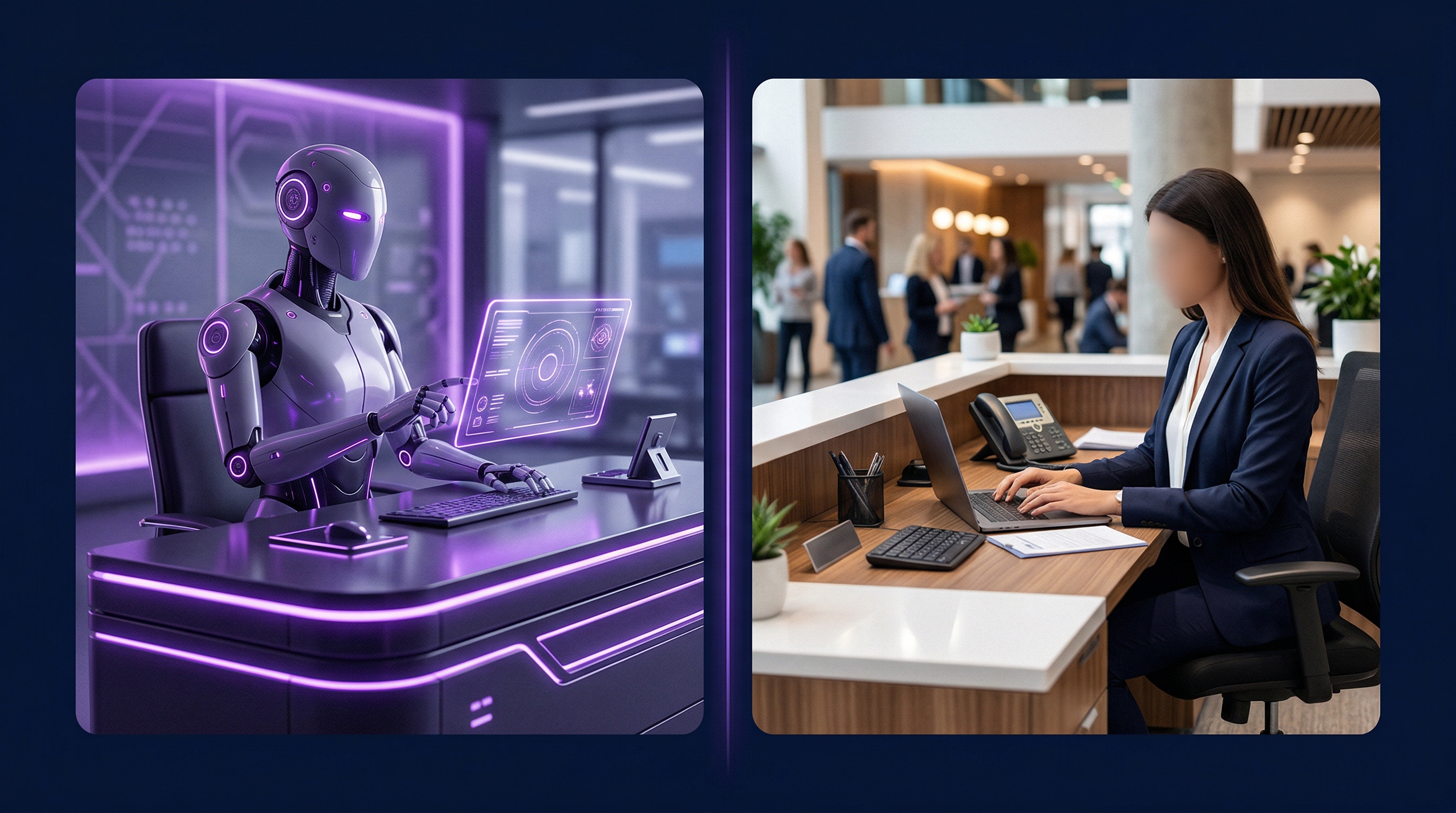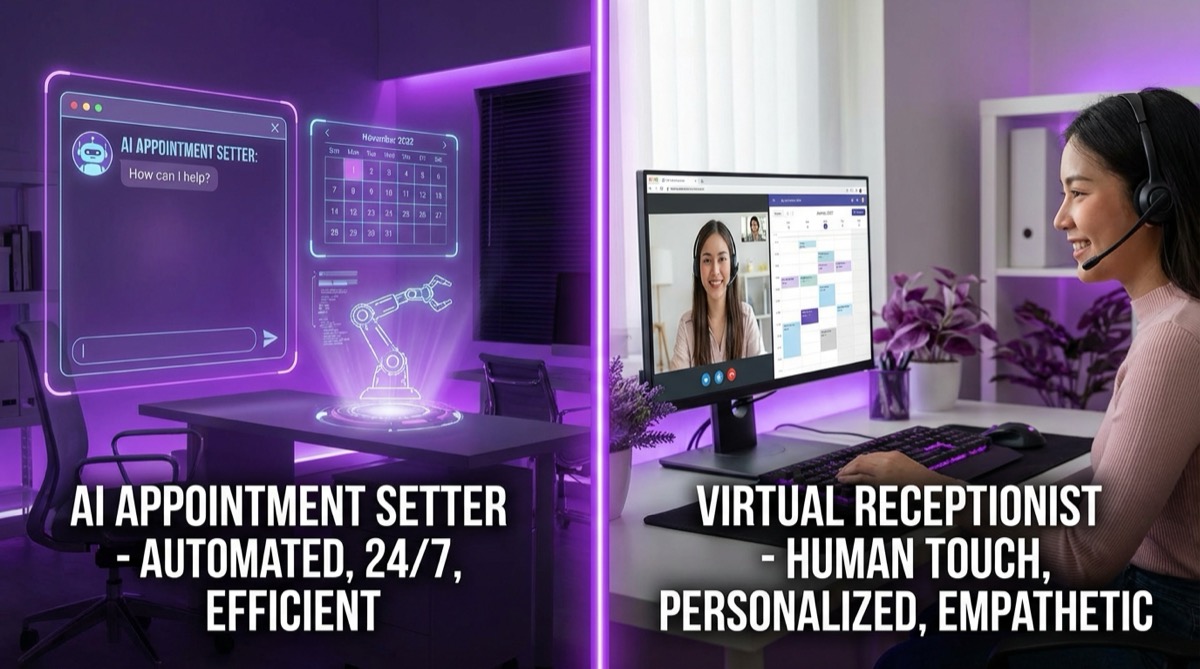
The terms "AI appointment setter" and "virtual receptionist" get used interchangeably, but they describe fundamentally different products with fundamentally different revenue impacts. Understanding the distinction before you buy prevents the most common mistake in this category: paying for an answering service when your business actually needs an appointment-booking engine.
An AI appointment setter books the appointment on the first call, while a virtual receptionist answers and takes a message, and booking during that first call converts at 3.5x the rate of a callback. This guide breaks down exactly what each category does, what it costs, and which one generates more revenue for your specific business type. The short version: if your revenue comes from booked appointments, you need an AI appointment setter. If your revenue comes from something else and you just need phones answered, a virtual receptionist works. For most service businesses, the answer is clear.
The Core Difference: Answering vs. Booking
A virtual receptionist answers your phone, greets the caller, collects basic information (name, number, reason for calling), and either takes a message or transfers the call to someone on your team. The caller gets a professional phone experience. You get a message. Whether that message becomes an appointment depends on how quickly your team calls back and whether the lead is still interested.
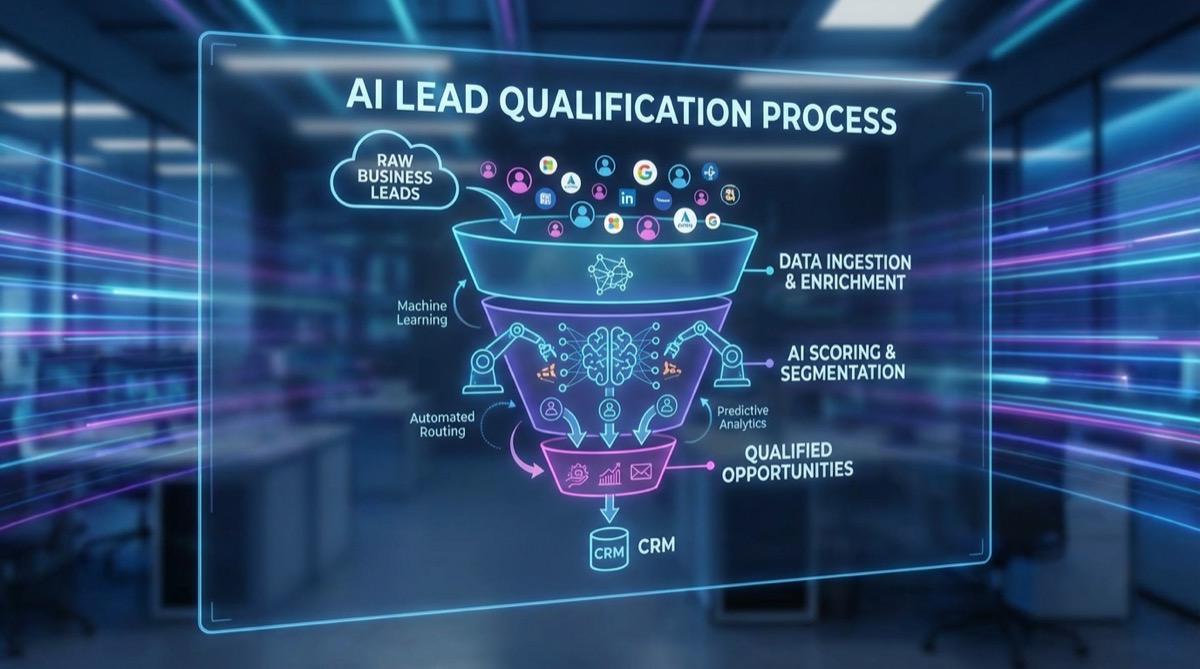
An AI appointment setter does everything a virtual receptionist does, plus it qualifies the lead, checks your real-time calendar availability, books a confirmed appointment, and sends the caller a confirmation. The caller gets a professional phone experience AND a booked appointment. You get revenue.
That distinction, booking the appointment during the call versus creating a callback task, is the single biggest driver of conversion rate in service businesses. Research from the Lead Response Management Study found that calling a lead back within 5 minutes converts at 8x the rate of calling back within 30 minutes. An AI appointment setter eliminates callback delay entirely by booking during the initial conversation.
A virtual receptionist creates a to-do item. An AI appointment setter creates revenue. The callback step is where most service businesses lose 30 to 50% of their leads.
Feature-by-Feature Comparison
| Capability | Virtual Receptionist | AI Appointment Setter |
|---|---|---|
| Answer inbound calls 24/7 | Yes | Yes |
| Professional greeting | Yes | Yes |
| Collect caller information | Yes | Yes |
| Lead qualification questions | Basic (name, number) | Advanced (service area, budget, urgency, timeline) |
| Check real-time calendar availability | No (message only) | Yes (live calendar integration) |
| Book confirmed appointment during call | No | Yes |
| Send appointment confirmation | No | Yes (SMS, email, or both) |
| CRM data sync | Limited (some offer basic integrations) | Yes (deep integrations with industry CRMs) |
| Call routing and transfers | Yes (basic) | Yes (intelligent, context-aware) |
| Handle multiple simultaneous calls | Depends on staffing | Unlimited concurrent capacity |
| Appointment reminders | No | Yes (automated) |
| Performance analytics | Basic call logs | Conversion rates, qualification data, booking rates |
The Revenue Impact: Real Numbers
To understand why the appointment-setting distinction matters financially, consider a typical HVAC company that receives 200 inbound calls per month and misses 60 of them (a 30% miss rate, which is conservative according to Numa's data).
Scenario 1: Virtual Receptionist
The virtual receptionist answers all 60 previously missed calls. It takes a message and sends it to the HVAC company's dispatcher. The dispatcher calls back when available, typically 15 to 45 minutes later. By that time, research shows that 30 to 50% of callers have already contacted a competitor. Of the remaining leads, the company converts at its normal rate of 20%.
Virtual Receptionist Revenue Recovery
Scenario 2: AI Appointment Setter
The AI appointment setter answers the same 60 calls. But instead of taking a message, it qualifies the lead, checks real-time availability, and books a confirmed appointment during the call. There is no callback delay. The lead is engaged, committed, and on the calendar before they hang up.
AI Appointment Setter Revenue Recovery
The AI appointment setter recovers $6,000 per month versus $3,120 for the virtual receptionist. That is a 92% difference in revenue recovery from the same set of calls, driven entirely by eliminating the callback step and booking during the conversation. The full ROI analysis shows even larger gaps in industries with higher ticket values like solar and roofing.
Get the Appointment Setter, Not Just the Receptionist
CallSetter AI answers calls, qualifies leads, and books confirmed appointments into your calendar. No callbacks needed. No leads lost to delay.
Book a DemoWhen a Virtual Receptionist Is Enough
Virtual receptionists are a good fit when your business does not depend on booked appointments as the primary revenue driver. Specifically:
- Retail businesses where callers ask about hours, inventory, and directions. There is no appointment to book.
- Businesses with dedicated sales teams that prefer to handle their own follow-up calls and have systems to ensure rapid callback.
- Low call volume businesses (under 50 calls per month) where the cost difference between virtual receptionist and appointment setter does not justify the upgrade.
- Businesses with complex, multi-step sales processes where booking a single appointment during the initial call is not how deals close (enterprise B2B, custom manufacturing, etc.).
When You Need an AI Appointment Setter
If any of the following describe your business, a virtual receptionist will leave significant revenue on the table. You need an AI appointment setter.
- Your revenue depends on booked appointments. Home services, dental, healthcare, real estate, solar, legal consultations. If no appointment = no revenue, you need real-time booking.
- You miss more than 20% of inbound calls. Every missed call that gets a callback instead of an instant booking loses 30 to 50% of its conversion potential.
- Your average ticket value exceeds $200. At higher ticket values, the revenue difference between a message and a booked appointment compounds dramatically. For a $22,000 solar installation, one additional booking per month justifies months of AI costs.
- Your business serves emergency or urgent needs. Plumbing emergencies, HVAC breakdowns, dental pain. These callers will not wait for a callback. If your virtual receptionist takes a message, the caller is booking with your competitor by the time your dispatcher sees it.
- You operate outside traditional business hours. After-hours calls are the highest-value calls in service industries because callers have fewer options and higher urgency. A virtual receptionist taking a message at 9 PM means a callback the next morning. An appointment setter books them at 9 PM for the next available slot.
CallSetter AI: Both in One
CallSetter AI functions as both a virtual receptionist and an AI appointment setter. Every inbound call gets a professional greeting, intelligent conversation, and the option to book a confirmed appointment during the call. Calls that do not need appointments (existing customers with questions, vendors, wrong numbers) are handled with the same professionalism as a high-quality virtual receptionist.
The platform is designed for home service companies, dental practices, healthcare providers, real estate agencies, and other appointment-based businesses. You get a dedicated account manager who writes your scripts, configures your CRM integrations, and optimizes your booking rates based on real performance data. Launch is handled for you, with flat monthly pricing and no per-call surprises.
Cost Comparison
| Solution | Monthly Cost | Revenue Impact | Net ROI |
|---|---|---|---|
| No answering solution (voicemail) | $0 | Losing $4,800+/mo in missed calls | Negative $4,800 |
| Virtual receptionist (message only) | $200 to $1,500 | Recovers ~$3,120/mo (with callback losses) | +$1,620 to $2,920 |
| CallSetter AI (appointment setter) | $297 to $597 | Recovers ~$6,000/mo (no callback losses) | +$5,403 to $5,703 |
The appointment setter costs roughly the same as a virtual receptionist but recovers nearly double the revenue. The difference comes entirely from eliminating callback delay and booking appointments in real time during the call. For a detailed walkthrough of these calculations, see the complete ROI analysis.
The Verdict
If your business depends on appointments, the choice is not between an AI appointment setter and a virtual receptionist. The choice is between an AI appointment setter and leaving money on the table. Virtual receptionists solve the "missed call" problem. AI appointment setters solve the "missed revenue" problem. For service businesses, healthcare practices, and any company where booked appointments drive revenue, the math overwhelmingly favors the appointment setter.