Lead qualification is the process of determining whether an inbound caller is a good fit for your business before you invest time and resources into serving them. In service businesses, unqualified leads waste an average of 27% of sales team time, according to Salesforce's 2024 State of Sales report. That is over a quarter of your team's capacity spent on callers who live outside your service area, cannot afford your services, or are not ready to buy.
AI voice agents solve this by qualifying leads during the initial phone conversation, automatically, 24 hours a day. The AI asks the right questions in a natural, conversational way, evaluates the responses in real time, and takes the appropriate action: booking qualified leads into your calendar, routing borderline leads to your team for follow-up, or politely disqualifying callers who are not a fit. This happens on every call, with perfect consistency, without your team lifting a finger.
The Lead Qualification Framework for Voice AI
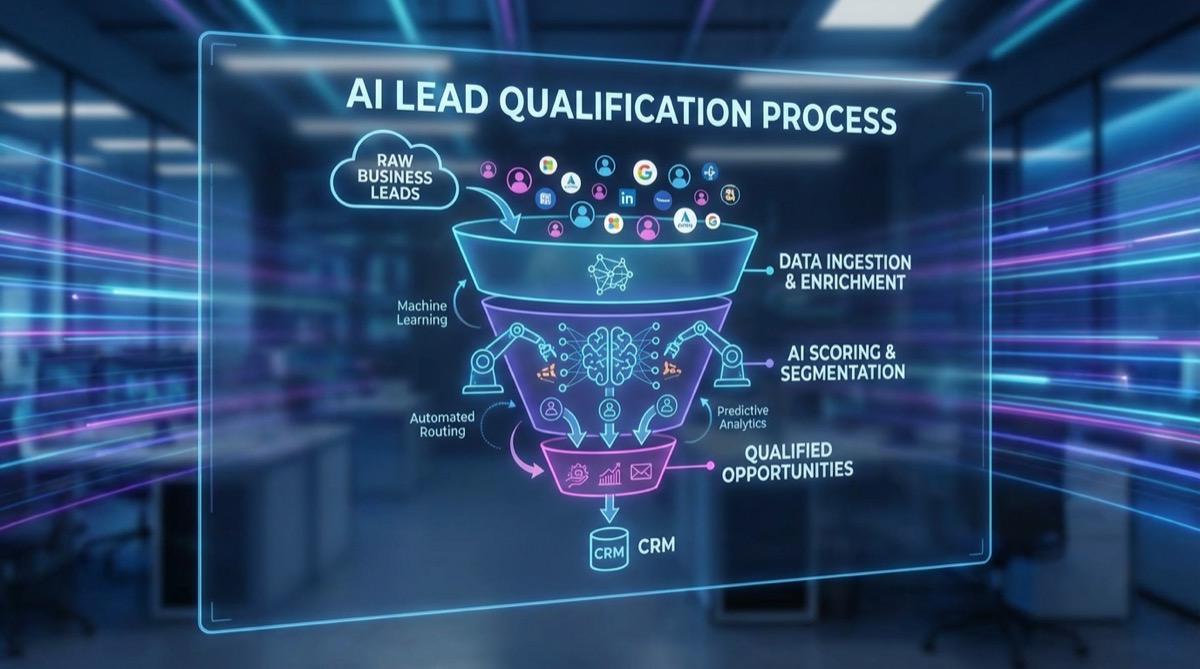
Effective lead qualification via voice AI follows a four-stage framework. Each stage builds on the previous one, and the AI adapts its approach based on the caller's responses. The goal is not to interrogate the caller. The goal is to have a natural conversation that captures the information your team needs to serve them well.
Stage 1: Intent Identification
The first stage determines why the caller is calling. In service businesses, inbound calls fall into roughly five categories: new service requests, existing customer issues, emergency situations, price shopping, and non-customer calls (vendors, solicitors, wrong numbers). Each category requires a different handling path.
The AI identifies intent within the first 15 to 30 seconds of conversation by asking a simple open-ended question: "How can I help you today?" or "What can we do for you?" The caller's response provides enough signal to route the conversation appropriately. New service requests proceed to qualification. Existing customers are routed to the right team member. Emergencies trigger immediate escalation protocols.
Stage 2: Fit Qualification
Once the AI identifies that the caller wants a new service, it determines whether the caller is a fit for your business. This stage asks three to five targeted questions specific to your industry and service offering.
For an HVAC company, fit qualification might include:
- Service area: "What is your zip code?" (Instantly checks against your coverage area.)
- Service type: "Are you looking for repair, maintenance, or a new installation?" (Routes to the right team or estimates.)
- Property type: "Is this for a residential home or a commercial property?" (Determines pricing tier and technician assignment.)
- Urgency: "Is your system completely down, or is this something we can schedule?" (Triages emergency vs. standard service.)
For a dental practice, the questions shift to:
- Patient status: "Are you a current patient or looking to become a new patient?"
- Service needed: "What brings you in? A cleaning, a specific concern, or a dental emergency?"
- Insurance: "Do you have dental insurance? If so, which provider?"
- Timeline: "How soon are you looking to come in?"
The AI asks these questions conversationally, not as a checkbox form. If the caller mentions they have a toothache, the AI does not rigidly proceed to ask about insurance next. It acknowledges the pain, asks relevant follow-up questions about severity and duration, and then collects the remaining qualification data naturally.
The best qualification feels like a helpful conversation, not a form being filled out. Callers should feel understood, not processed. That is what separates AI voice agents from IVR phone trees.
Stage 3: Lead Scoring
Based on the caller's responses, the AI assigns a qualification score that determines the handling path. Most businesses benefit from a simple three-tier scoring system.
Lead Scoring Tiers
Hot leads meet all qualification criteria: they are in the service area, need a service you offer, have the budget or insurance, and want to schedule soon. The AI books them directly into your calendar during the call. No delay, no callback, no opportunity for them to call a competitor.
Warm leads meet most criteria but have one open question. Maybe they are not sure about their budget, or they need a service that requires a custom quote. The AI can either book a consultation appointment or route the call to a team member who can address the open question while the lead is still engaged.
Cold leads are outside your service area, need something you do not offer, or are clearly not ready to buy. The AI handles these politely: "I appreciate you calling. Unfortunately, we do not serve that area. I can recommend a provider closer to you." This saves your team from spending 10 minutes on a call that was never going to convert.
Stage 4: Action and Data Capture
The final stage converts the qualification into action. For qualified leads, this means booking the appointment, sending the confirmation, and pushing all captured data to your CRM. For disqualified leads, it means logging the interaction for analytics (so you can identify patterns in where disqualified leads come from) and, optionally, adding them to a nurture sequence for future follow-up.
Every piece of data captured during the qualification conversation is logged and available for analysis. Over time, this data reveals patterns: which marketing channels produce the highest-quality leads, what times of day generate the most bookings, which service types are most requested, and where disqualification happens most often. This intelligence feeds back into your marketing and operations strategy.
Qualify Every Lead. Book Every Appointment.
CallSetter AI qualifies inbound leads using custom criteria for your industry, then books qualified callers directly into your calendar.
Book a DemoIndustry-Specific Qualification Examples
HVAC Qualification
An HVAC company's AI qualification focuses on service area, system type, urgency, and whether the caller owns the property (renters often need landlord approval). The AI also identifies whether the call is for residential or commercial service, as these require different technicians, pricing, and scheduling. Emergency calls (system completely down in extreme temperatures) trigger immediate escalation with estimated arrival times. Read more about AI for HVAC companies.
Dental Practice Qualification
Dental qualification prioritizes new patient vs. existing patient, insurance verification, and urgency. A caller with severe pain gets same-day emergency scheduling. A caller wanting a routine cleaning gets the next available appointment. A caller without insurance gets information about payment plans before booking. The AI captures all this information and pushes it to the practice management system so the front desk team has full context before the patient arrives. Learn how dental practices use CallSetter.
Solar Installation Qualification
Solar qualification has the longest sales cycle and the most qualification criteria. The AI needs to determine: Does the caller own their home? Is the roof in good condition? What is their average monthly electricity bill? Are they looking to buy outright or finance? What is their timeline? According to EnergySage's 2024 data, 60% of solar leads are not viable due to property ownership, roof condition, or budget constraints. AI qualification identifies these non-starters instantly, saving your sales team from site visits that will never close. See the solar industry page for more.
Healthcare Qualification
Healthcare businesses require HIPAA-compliant qualification. The AI collects only the minimum necessary information during the phone call: reason for visit, insurance provider, new vs. existing patient status, and scheduling preferences. Sensitive medical information is captured only to the extent needed for proper routing and scheduling. All interactions are logged with appropriate security controls.
AI Qualification vs. Human Qualification
| Factor | Human Qualification | AI Voice Agent Qualification |
|---|---|---|
| Consistency | Varies by person, time of day, mood | 100% consistent on every call |
| Availability | Business hours only (or expensive overtime) | 24/7/365 |
| Speed | 2 to 5 min per qualification | 1 to 3 min per qualification |
| Questions asked | Often skipped under pressure | Every required question, every time |
| Data capture | Manual notes, often incomplete | Automatic, structured, 100% complete |
| Simultaneous capacity | 1 call at a time per person | Unlimited concurrent calls |
| Bias | Unconscious bias can affect scoring | Objective criteria-based scoring |
| Cost per qualification | $8 to $15 (based on receptionist time) | $1 to $3 |
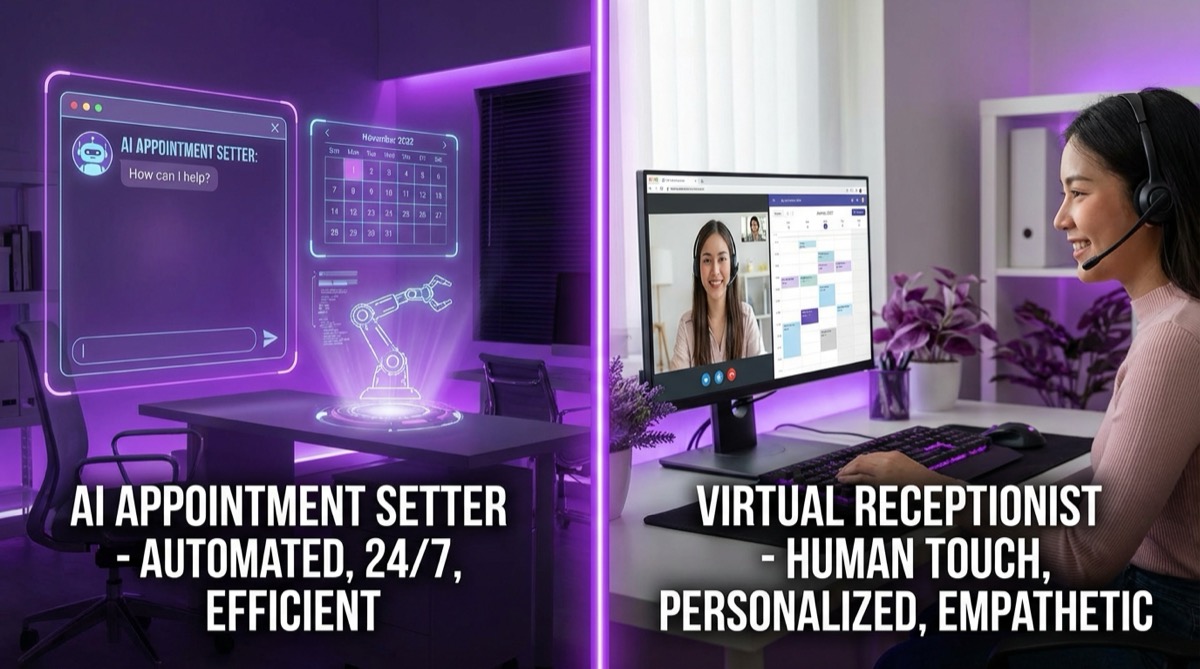
The key advantage of AI qualification is not that it is smarter than humans. It is that it is perfectly consistent. A human receptionist at 4:45 PM on Friday will not ask the same questions with the same thoroughness as they did at 9:15 AM on Monday. The AI does. Every call. Every time. That consistency compounds into a measurable difference in lead quality data and booking rates over weeks and months.
How CallSetter AI Implements Lead Qualification
CallSetter AI builds custom qualification scripts for each client based on their specific industry, service area, service offerings, and ideal customer profile. During onboarding, a dedicated account manager works with you to define your qualification criteria, scoring thresholds, and handling rules for each lead tier.
The qualification logic is then embedded into the voice agent's conversation flow. It does not feel like a form being filled out. It feels like a knowledgeable receptionist having a helpful conversation. The AI adapts based on caller responses, asks relevant follow-ups, and captures all data in structured format that flows directly to your CRM.
After launch, the account manager reviews qualification data weekly and adjusts the criteria based on actual results. If certain questions are causing callers to drop off, they get rephrased. If a qualification criterion is too strict (disqualifying leads that actually convert), it gets loosened. This ongoing optimization is what separates a managed service like CallSetter from DIY voice agent platforms where you are responsible for everything.
Measuring Qualification Effectiveness
Four metrics tell you whether your AI lead qualification is working.
- Qualification rate: What percentage of inbound calls pass qualification? If this number is below 40%, your marketing may be attracting the wrong audience. If it is above 80%, your criteria may be too loose.
- Booking rate: What percentage of qualified leads book an appointment during the call? Best-in-class voice agents achieve 60 to 75% booking rates on qualified leads.
- Show rate: What percentage of booked appointments actually show up? AI-booked appointments with automated confirmations and reminders typically see 85 to 92% show rates.
- Close rate on qualified leads: What percentage of qualified, booked leads become paying customers? If this is significantly lower than your historical average, the qualification criteria need tightening.
Together, these four metrics create a qualification funnel that you can optimize at each stage. Most businesses see the biggest improvement in the booking rate stage, where eliminating callback delay (booking during the call instead of taking a message) drives a 2 to 3x improvement over traditional methods.