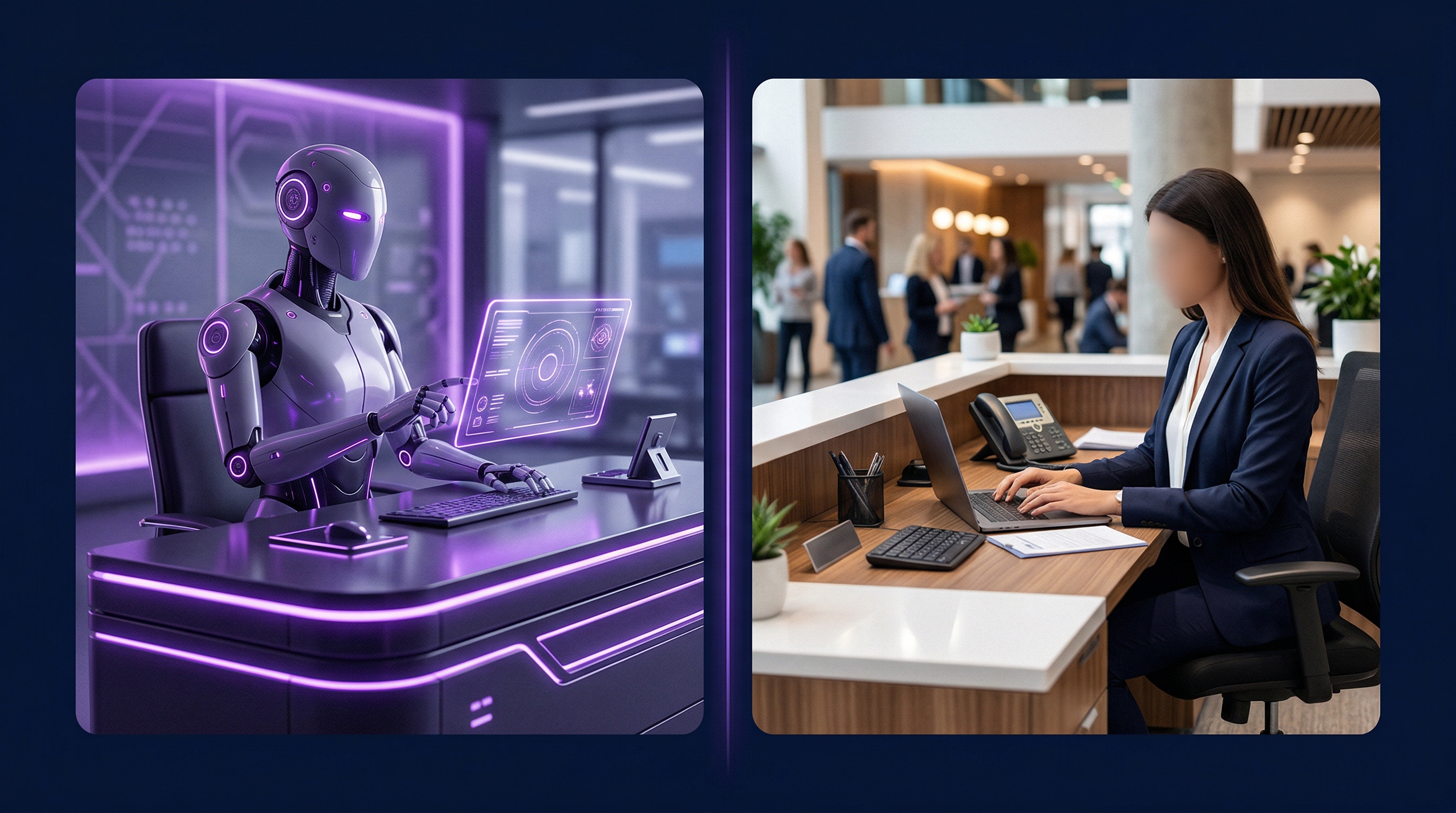
The question is no longer whether AI receptionists work. The technology has matured to the point where AI voice agents handle appointment scheduling, lead qualification, and call routing with near-human conversational quality. The real question for business owners in 2026 is this: what is the true cost of a human receptionist compared to an AI receptionist, and where does each option make sense?
An AI receptionist covers all 8,760 hours in a year, while a single full time human receptionist covers roughly 2,000 of them, and the BLS puts total compensation at 29.4% above wages on top of that. This is not a philosophical debate about robots replacing humans. This is a spreadsheet decision. The numbers tell a clear story, and by the end of this article you will have the exact data you need to make the right call for your business.
The Full Cost of a Human Receptionist
When business owners think about the cost of a receptionist, they typically think about salary. But salary is only the beginning. The Bureau of Labor Statistics reports the median annual wage for receptionists at $36,920 as of May 2023. In major metro areas (New York, Los Angeles, San Francisco), that number climbs to $42,000 to $50,000. Here is the complete cost picture.
Direct Compensation
- Base salary: $32,000 to $50,000 per year depending on location (BLS, 2023)
- Benefits: Health insurance, PTO, sick days, 401(k) match. The BLS estimates total compensation costs are 29.4% above wages for private industry workers, adding $9,400 to $14,700 annually.
- Payroll taxes: FICA (7.65%), unemployment insurance, workers comp. Approximately $2,800 to $4,300 per year.
- Total annual cost per receptionist: $44,200 to $69,000
Hidden Costs
- Recruitment: Average cost to hire a receptionist is $4,700 per hire (SHRM 2022 Talent Acquisition Benchmarking Report).
- Training: 2 to 4 weeks of onboarding, during which productivity is reduced. Estimated cost: $1,000 to $3,000 in trainer time and materials.
- Turnover: The median tenure for receptionists is 2.4 years (BLS). You will recruit, hire, and train a replacement every 2 to 3 years. Annual turnover cost amortized: $2,000 to $3,000 per year.
- Absenteeism: The average U.S. worker misses 7.8 days per year due to illness or personal reasons (BLS, 2023). Each absent day requires coverage or means missed calls.
- Workspace: Desk, phone, computer, headset, supplies. One-time setup: $2,000 to $5,000. Annual maintenance: $500 to $1,000.
The 24/7 Coverage Problem
A single full-time receptionist covers roughly 2,000 hours per year (40 hours x 50 weeks). A year has 8,760 hours. That means one receptionist covers only 23% of the hours in a year. To achieve true 24/7 coverage, you need a minimum of 4.4 full-time equivalents (FTEs), which means hiring at least 5 people to account for PTO, sick days, and shift gaps.
Total annual cost for 24/7 human receptionist coverage: $221,000 to $345,000 per year. For most small businesses with annual revenue under $2 million, this is simply not feasible.
The Full Cost of an AI Receptionist
AI receptionist pricing in 2026 falls into three general tiers, based on a review of published pricing from major providers including Smith.ai, My AI Front Desk, Dialzara, and CallSetter AI.
| Cost Category | AI Receptionist | Human Receptionist |
|---|---|---|
| Monthly cost | $99 to $499 | $3,683 to $5,750 |
| Annual cost | $1,188 to $5,988 | $44,200 to $69,000 |
| Setup / onboarding | $0 to $500 (one-time) | $5,700 to $8,000 |
| Training | Included (prompt configuration) | $1,000 to $3,000 per hire |
| Benefits / taxes | $0 | $12,200 to $19,000/year |
| Turnover cost | $0 | $4,700 per replacement |
| 24/7 coverage cost | Same price (included) | $221,000 to $345,000/year (5 FTEs) |
An AI receptionist provides 24/7 coverage at 2 to 3% of the cost of staffing human receptionists around the clock. For a small business, this is the difference between affording coverage and not.
Head-to-Head Comparison: 8 Key Factors
1. Availability
AI: 24 hours a day, 7 days a week, 365 days a year. No breaks, no sick days, no holidays, no shift changes. Answers on the first ring.
Human: 8 to 10 hours per day, Monday through Friday for most small businesses. Lunch breaks, bathroom breaks, PTO, and sick days create gaps. Ruby Receptionists reports that 35% to 45% of calls to service businesses come outside of standard hours.
Winner: AI. The gap is massive and has direct revenue implications. Every after-hours call that goes to voicemail is a lost opportunity (85% of callers will not call back, per Numa 2021).
2. Call Capacity
AI: Handles unlimited simultaneous calls. During a Monday morning rush or after a marketing campaign launch, the AI answers every call instantly regardless of volume.
Human: One call at a time per person. When the receptionist is on a call, the next caller gets hold music or voicemail. During peak periods, overflow is inevitable without additional staff.
Winner: AI. No capacity ceiling means zero missed calls during high-volume periods.
3. Consistency
AI: Every call follows the same script, qualification criteria, and booking process. Performance does not vary based on mood, fatigue, time of day, or whether the caller is difficult. A 2023 Gartner survey found that 64% of business leaders say AI provides more consistent customer experiences than human agents.
Human: Performance varies by individual, time of day, workload, and personal factors. Monday mornings are different from Friday afternoons. The receptionist who has been on the phone for 6 hours straight will not deliver the same quality as the one who just started their shift.
Winner: AI. Consistency eliminates the variability that causes some leads to slip through the cracks.
4. Lead Qualification
AI: Follows a structured qualification flow every time: service needed, location, urgency, budget indicators, contact information. Never forgets to ask a qualifying question. Never gets flustered by a difficult caller.
Human: Can read emotional cues, handle unusual situations, and exercise judgment in ambiguous scenarios. May forget qualifying questions when busy, may not follow the script consistently, may prioritize being friendly over being thorough.
Winner: Tie. AI is more consistent, humans are more adaptable. For standardized qualification (HVAC, plumbing, dental, legal intake), AI wins on thoroughness. For complex B2B sales, humans still have an edge.
5. Appointment Booking
AI: Checks real-time calendar availability and books the appointment during the call. No callback needed. The customer goes from inquiry to confirmed appointment in under 3 minutes.
Human: Can book appointments but must toggle between phone and scheduling software. During busy periods, may take a message and call back to schedule, adding delay. A CallRail study found that callbacks result in 50% lower conversion rates compared to booking during the initial call. The speed-to-lead research confirms that response time is the single most important variable in lead conversion.
Winner: AI. Real-time booking during the initial call captures the lead at peak intent.
See How AI Reception Works in Practice
CallSetter AI answers every call, qualifies the lead, and books the appointment in under 3 minutes. No hold times. No missed calls. No callbacks needed.
Book a Demo6. Training and Onboarding
AI: Configuration takes 1 to 3 days. Once set up, the AI is fully operational with zero ramp-up period. Updates to scripts, pricing, or services can be made instantly.
Human: 2 to 4 weeks of onboarding for a new hire. During that period, call handling quality is reduced while the receptionist learns your services, pricing, scheduling system, and FAQ responses. Every time you hire a replacement (every 2.4 years on average), you repeat this process.
Winner: AI. Zero ongoing training costs and instant updates.
7. Scalability
AI: Adding a second location, a new service line, or handling 3x call volume requires zero additional cost. The same AI handles 50 calls per day as easily as 500.
Human: Scaling requires hiring, which means recruitment costs, interviews, training, and management overhead. Lead time to hire and train a new receptionist: 4 to 8 weeks (SHRM benchmarks). Scaling is expensive and slow.
Winner: AI. Scales instantly at no additional cost.
8. The Human Touch
AI: Modern AI voice agents are conversational and natural, but they are not human. Some callers (particularly older demographics) may prefer speaking to a person. A 2023 Salesforce survey found that 57% of consumers prefer human agents for complex issues.
Human: Genuine empathy, cultural sensitivity, ability to handle emotional situations (personal injury intake, medical emergencies, distressed homeowners). Humans can build rapport in ways AI cannot fully replicate yet.
Winner: Human. For high-empathy situations (legal intake, healthcare, crisis calls), human warmth matters. For routine scheduling and qualification, the difference is negligible.
When to Use AI, When to Use Humans, When to Use Both
AI Receptionist Is the Better Choice When:
- You need 24/7 coverage and cannot afford 5 FTEs
- Your primary call volume is appointment scheduling and lead qualification
- You are in a high-volume, time-sensitive industry (home services, dental, real estate)
- You want to eliminate missed calls entirely
- Your business is growing and you need to scale call handling without proportional hiring
Human Receptionist Is the Better Choice When:
- Your calls require complex judgment (high-value B2B sales, crisis counseling)
- Your clientele strongly prefers human interaction (luxury services, high-net-worth clients)
- Your receptionist handles significant in-person duties (greeting visitors, managing deliveries)
The Hybrid Model (Best of Both Worlds)
The most effective approach for many businesses is a hybrid model: AI handles after-hours calls, overflow during peak hours, and routine scheduling. Human staff handles complex calls, in-person interactions, and high-empathy situations during business hours. This captures the cost savings and 24/7 availability of AI while preserving the human touch where it matters most.
The question is not AI or human. The question is: what combination of AI and human gives your business the best coverage, the best customer experience, and the best ROI? For most service businesses, that answer is AI for 80% of calls and human for the 20% that require judgment and empathy.
The Bottom Line: ROI Comparison
For a home services company receiving 300 calls per month with a $400 average ticket value, here is the annual ROI comparison.
Current state (no receptionist, 22% missed calls): 66 missed calls per month x $400 = $26,400/month lost = $316,800/year lost.
Human receptionist ($50,000/year, business hours only): Captures daytime calls but still misses 35% of after-hours calls. Estimated recovery: 60% of lost revenue = $190,080. Net ROI: $140,080 per year.
AI receptionist ($199/month, 24/7): Captures nearly all calls including after-hours. Estimated recovery: 90% of lost revenue = $285,120. Net ROI: $282,732 per year (after $2,388 annual cost).
The AI receptionist delivers 2x the ROI of a human receptionist at 5% of the cost. The data is clear. The only question is when you start.