
The cost of missed calls for a small service business averages $126,000 a year, and every time your phone rings and nobody picks up, more of it walks out the door. Not a small amount. Not a rounding error. Here are the 2026 statistics on the cost of missed calls for service businesses, industry by industry. According to a 2019 analysis by BIA/Kelsey, phone calls to businesses influence over $1 trillion in U.S. consumer spending annually. For the average small business, the math is brutal: a single missed call can cost anywhere from $200 to $50,000 depending on the industry, and the callers who do not get through almost never try again.
Embed this chart (free, attribution required)
This is not a theoretical problem. A 2021 study by Numa found that small businesses miss an average of 22% of incoming calls. For businesses that rely on phone leads as a primary revenue channel (home services, healthcare, legal, real estate), that 22% translates directly into six figures of lost annual revenue. The fix is an AI call appointment setter that answers every call in seconds, not hours.
What this guide covers

Why 85% of Callers Never Call Back
The statistic that should keep every business owner up at night comes from Numa's 2021 research on small business phone behavior: 85% of callers who reach voicemail or get no answer will not try again. They will call the next result on Google instead.
This behavior makes perfect sense from the customer's perspective. When someone calls a plumber because their basement is flooding, they are not conducting a leisurely vendor evaluation. They need help now. If the first company does not answer, the second company gets the job. The customer's problem is too urgent to leave a voicemail and hope for a callback.
When someone calls your business and nobody answers, they do not wait. They call your competitor. And 85% of the time, they never try you again.
Numa, 2021 Small Business Phone ReportEven for non-emergency calls, the psychology is the same. A 2022 report by Invoca found that 75% of consumers say that a phone call is the fastest way to get a response from a business. When that expectation is violated by a missed call, the trust deficit is immediate and permanent. The caller assumes you are too busy, understaffed, or disorganized to help them.

The Industry-by-Industry Breakdown
The cost of a missed call varies dramatically by industry because the average transaction value and customer lifetime value differ across verticals. Here is what the data shows for the industries most dependent on inbound calls.
| Industry | Revenue Per Missed Call | Emergency / High End | Source |
|---|---|---|---|
| HVAC | $300 to $500 | $1,500 to $5,000+ | ACHR News |
| Dental | $653 first-year value | $10,000 to $25,000 lifetime | ADA / Levin Group |
| Legal | $3,000 to $50,000+ | $100,000+ contingency fees | Clio |
| Plumbing | $350 to $500 | $750 to $2,500 | ServiceTitan |
| Electrical | $250 to $1,200 | ServiceTitan | |
| Real Estate | $10,000 to $12,000 commission | NAR |
HVAC: $300 to $500 Per Missed Call
The average HVAC service call generates $300 to $500 in revenue, according to ACHR News industry reports. Emergency calls (system failures in extreme weather) average $1,500 to $5,000+. An HVAC company receiving 200 inbound calls per month that misses 22% of them is losing approximately 44 calls. At $400 average ticket value, that is $17,600 per month or $211,200 per year in lost revenue.
The loss compounds because HVAC service calls frequently lead to upsell opportunities. A $400 repair call often reveals the need for a $6,000 to $12,000 system replacement. When you miss the initial call, you lose both the service ticket and the potential equipment sale.
Dental Practices: $653 Per Missed New Patient Call
The American Dental Association reports that the average new patient is worth $653 in first-year revenue from their initial visit, X-rays, cleaning, and treatment planning. The lifetime value of a dental patient is $10,000 to $25,000 over a typical 15 to 20 year relationship, according to the Levin Group's dental practice benchmarking data.
A dental practice that misses 15 new patient calls per month (common for practices running Google Ads or ranking well locally) is leaving $9,795 per month in first-year revenue on the table. Over a year, that is $117,540 in first-year revenue alone, not counting the lifetime value of those lost patients.
Legal: $3,000 to $50,000+ Per Missed Intake Call
For law firms, the stakes are the highest of any industry. According to Clio's 2023 Legal Trends Report, the average matter value varies from $3,000 for simple cases to $50,000+ for personal injury, family law, or commercial litigation. Personal injury cases can represent $100,000+ in contingency fees.
A personal injury firm that misses even 5 qualified intake calls per month could be losing $250,000 to $500,000 in annual case value. The callers are often in distress, seeking immediate help, and will retain the first attorney who answers their call.
Plumbing and Electrical: $250 to $2,500 Per Missed Call
ServiceTitan's 2023 industry data shows that the average plumbing service ticket is $350 to $500, with emergency calls averaging $750 to $2,500. Electrical service calls average $250 to $1,200. A plumbing company missing 30 calls per month at an average ticket of $450 loses $13,500 monthly, or $162,000 annually.
Real Estate: $3,000 to $15,000 Per Missed Lead
According to the National Association of Realtors (NAR), the average buyer agent commission on a $400,000 home is approximately $10,000 to $12,000. Real estate leads that go unanswered have a conversion window of minutes, not hours. A Zillow study found that agents who respond within 5 minutes are 100x more likely to connect with the lead than those who wait 30 minutes. Insurance agencies face the same urgency on every quote request, which is why we broke down AI appointment setting for insurance agencies separately.
Stop Losing Revenue to Missed Calls
CallSetter AI answers every call in under 60 seconds, qualifies the lead, and books the appointment. Zero missed calls. Zero lost revenue. 24/7/365.
Book a Demo
When Missed Calls Hurt the Most
Not all missed calls are equal. Certain conditions make missed calls exponentially more costly because the caller's intent and urgency are at their peak.
After-Hours Calls (35 to 45% of All Calls)
Research from Ruby Receptionists shows that 35% to 45% of calls to service businesses come outside of standard 9 to 5 hours. These are often the highest-value calls because they represent urgent situations: a burst pipe at midnight, a broken furnace on a Saturday, a toothache on Sunday morning. Businesses that cannot answer after-hours calls are missing their most valuable leads.
Peak Volume Periods
ServiceTitan data shows that home service companies receive 40% of their weekly call volume on Monday and Tuesday mornings. When your receptionist is already on a call and three more come in simultaneously, the overflow goes to voicemail. During seasonal peaks (first cold snap for HVAC, spring thaw for plumbers), call volume can spike 200 to 300% above normal, according to ACHR News seasonal data.
During Active Marketing Campaigns
When a business is running Google Ads, direct mail, or TV spots, call volume increases dramatically. According to Google's 2022 Ads benchmarking data, businesses running Local Services Ads see 2x to 5x their normal call volume. The speed-to-lead data makes this even more critical: leads contacted within 5 minutes are 21x more likely to qualify. If the business does not have capacity to answer all those additional calls, the ad spend is partially wasted. You are paying to generate leads that nobody answers.

The Hidden Costs Beyond Lost Revenue
The direct revenue loss from missed calls is only the beginning. There are compounding costs that multiply the damage over time. No-shows pile on too: see how AI cuts dental appointment no-shows by 34%.
Wasted Marketing Spend
If you spend $5,000 per month on Google Ads and 22% of the resulting calls go unanswered, you are burning $1,100 per month in ad spend. That is $13,200 per year in marketing dollars that generated leads you never spoke to. According to WordStream's 2023 benchmarking data, the average cost per lead for home services Google Ads is $45 to $75. Every missed call represents $45 to $75 in wasted acquisition cost, on top of the lost revenue.
Negative Reviews and Reputation Damage
BrightLocal's 2023 Consumer Review Survey found that 98% of consumers read online reviews for local businesses. Customers who cannot reach a business by phone are significantly more likely to leave a negative Google review. A single one-star review can reduce click-through rates by 11%, according to ReviewTrackers research from 2022. Over time, a pattern of poor responsiveness destroys local search rankings and reputation.
Reduced Referral Generation
Customers who have a positive first contact experience are 4x more likely to refer others, according to the Wharton School of Business referral research (Schmitt et al., 2011). When a potential customer cannot reach you by phone, you lose not just their business but the referral chain they would have generated. A single lost customer can mean 3 to 5 lost referrals over the following year.

How to Calculate Your Missed Call Cost
Here is a simple formula to estimate how much missed calls cost your specific business. Pull your actual numbers and plug them in.
- Monthly inbound calls: Check your phone system or Google Ads call report
- Missed call rate: Most phone systems track this. If yours does not, use the 22% industry average from the Numa study.
- Missed calls per month: Monthly calls x missed call rate
- Average revenue per call: Your average ticket or first-visit revenue
- Monthly lost revenue: Missed calls x average revenue per call
- Annual lost revenue: Monthly lost revenue x 12
For example: An HVAC company with 250 monthly calls, a 22% miss rate (55 missed calls), and a $400 average ticket is losing $22,000 per month or $264,000 per year. Even if only 50% of those missed calls were qualified leads, the loss is still $132,000 annually.
Your Missed Call Cost Calculator
Plug in your own numbers. Everything runs in your browser. No form, no email gate.
The formula, in the open: missed calls per week x average job value x close rate = revenue at risk per week. We multiply the weekly number by 52 for the year and divide the yearly number by 12 for the month. This is an estimate built only from your inputs. There are no hidden multipliers.

The Three Solutions (and Why Only One Scales)
For a map of the whole category and every vendor type, see the missed call services market overview. Prefer the raw numbers? They are compiled in our missed call statistics roundup.
Option 1: Hire More Staff
A full-time receptionist costs $32,000 to $45,000 per year in salary, plus benefits, training, and management overhead. For a full breakdown, see our AI receptionist vs human receptionist cost comparison. According to the Bureau of Labor Statistics (BLS), the median annual wage for receptionists was $36,920 as of May 2023. To cover evenings and weekends requires at least 2 to 3 additional part-time hires. Total cost for 24/7 phone coverage with human staff: $120,000 to $200,000 per year, plus turnover costs (average receptionist tenure is under 2 years, per BLS data).
Option 2: Answering Services
Traditional answering services charge $200 to $1,500 per month plus per-call fees of $1 to $3 per call. They take messages and forward them, but they do not qualify leads, check availability, or book appointments. The lead still waits for a callback, which means you still lose the speed-to-lead advantage. A 2023 Clutch survey found that 67% of consumers say they would rather interact with an AI than wait on hold or leave a message.
Option 3: AI Call Answering
AI voice agents answer every call instantly, 24/7/365. They qualify the caller, check your real-time calendar availability, and book the appointment on the spot. No hold times. No voicemails. No callbacks needed. The cost is typically $99 to $499 per month, a fraction of either human receptionist or answering service solutions, with zero capacity constraints. If you are comparing AI providers, see how CallSetter AI compares to Setter AI on setup, support, and price.
Embed this chart (free, attribution required)
The businesses that eliminate missed calls do not just recover lost revenue. They create a competitive moat. When every competitor in your market misses 22% of calls and you miss zero, the compounding advantage is enormous.
Where to Go Next, Based on Your Situation
- You want to see the fix on your own phone line: book a CallSetter AI demo. We estimate what your missed calls cost, then show the AI answering and booking live.
- You want to know what it costs first: see CallSetter AI pricing, or the full market breakdown of AI appointment setting cost across 8 providers.
- Most of your misses happen at night or on weekends: read the guide to AI phone answering for after-hours calls.
- You already text customers back: compare that workflow against missed call text back done automatically.
- You want your industry's numbers and setup: HVAC, plumbing, roofing, solar, dental, med spas, or law firms. Solar teams should start with the solar appointment setting guide.

The Compounding Cost of Inaction
Missed calls are not a one-time loss. They compound. Every missed call is a customer who goes to a competitor, has a positive experience there, and never comes back. That competitor now has a customer who refers friends and family. Your missed call did not just cost you one sale. It funded your competitor's growth.
Over 5 years, a business missing $126,000 in annual revenue from unanswered calls has lost $630,000. Factor in the lifetime value of those customers (repeat purchases, referrals, upsells) and the true 5-year cost is closer to $1.5 to $2 million for an average service business. The solution costs less than $6,000 per year. The math is not complicated. See exact plans on the CallSetter AI pricing page.
Frequently Asked Questions
How much does a missed call cost a small business?
The average missed call costs a small business $1,200 in lost lifetime customer value. For specific industries: HVAC companies lose $300-500 per missed call, dental practices lose $653 per patient, and legal firms lose $1,000-5,000 per potential case. Across all industries, the average small business loses approximately $126,000 per year from missed calls.
What percentage of callers call back after a missed call?
Only 15% of callers will try again after reaching voicemail or getting no answer. That means 85% of missed calls are permanently lost opportunities. Forrester research shows that 80% of callers sent to voicemail will not leave a message and will instead call a competitor.
How many calls does the average small business miss per week?
The average small business misses 6-8 calls per week during business hours and an additional 10-15 calls after hours, on weekends, and during holidays. Service businesses like HVAC, plumbing, and electrical contractors miss even more because technicians are on job sites and cannot answer the phone. Compare options in our guide to the best AI answering service for contractors.
When do most missed calls happen?
62% of missed business calls happen during three peak windows: before 9 AM, during lunch (11:30 AM to 1:30 PM), and after 5 PM. After-hours calls account for 35-40% of all incoming calls for service businesses. Weekends and holidays generate 20-25% of total call volume for emergency service providers.
How can AI reduce missed calls for small businesses?
AI phone answering systems pick up every call in under 2 seconds, 24/7/365, including nights, weekends, and holidays. They answer customer questions, qualify leads, book appointments, and transfer urgent calls to on-call staff. Businesses using AI call answering report capturing 40-60% more leads than those relying on voicemail or after-hours services.
What is the ROI of never missing a call?
If a business misses 30 calls per month and each missed call represents $400 in potential revenue, that is $12,000 per month or $144,000 per year in lost revenue. An AI answering system that costs $200-400 per month and captures even 50% of those missed opportunities generates $6,000 per month, a 15-30x return on investment.
Methodology and Sources
Every statistic on this page traces to a named source. Where the original report is no longer online, we link to the publisher's research hub. Figures marked as CallSetter AI examples are plain arithmetic on stated inputs, not third-party research. All source links were checked live on July 11, 2026.
- $1 trillion in call-influenced consumer spending: BIA/Kelsey, 2019 analysis. bia.com
- 22% of calls missed; 85% of callers never call back: Numa, 2021 Small Business Phone Report. numa.com
- $126,000 average annual loss; 75% say a call is the fastest response channel: Invoca, 2022 Call Intelligence Report. invoca.com
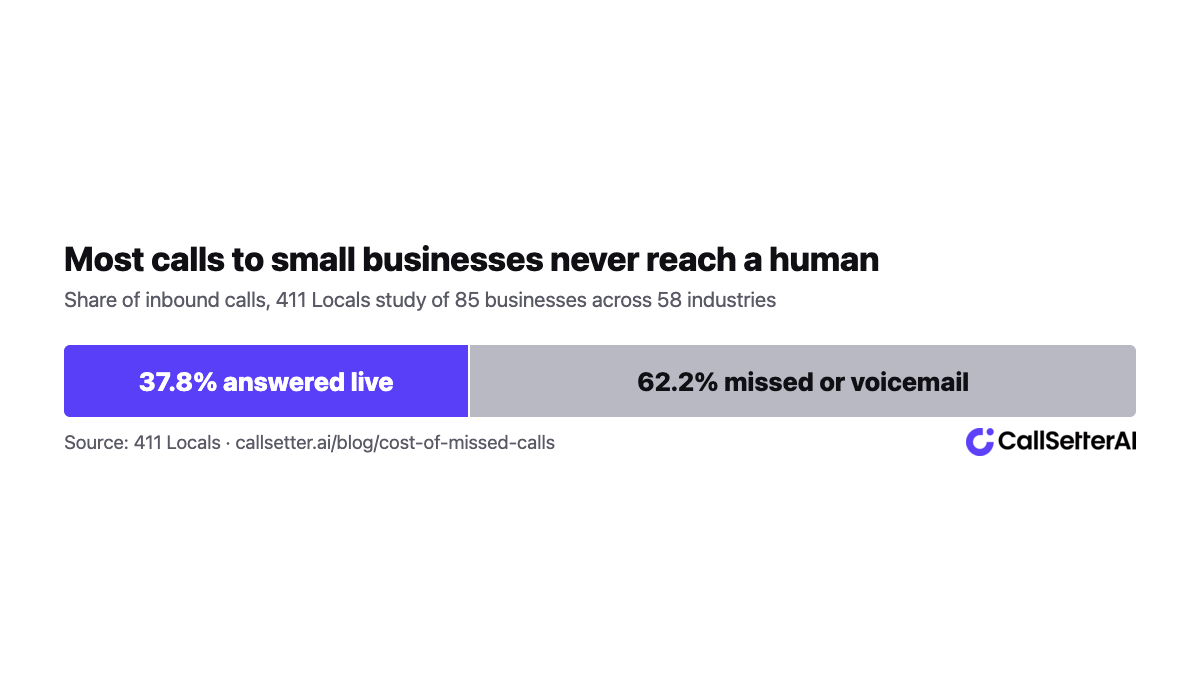
- 62% of calls unanswered or sent to voicemail: reported by Forbes (2020). The related answered-live study (37.8%) is from 411 Locals. 411locals.com
- HVAC ticket values and 200-300% seasonal call spikes: ACHR News industry reporting. achrnews.com
- $653 first-year new dental patient value: American Dental Association. ada.org
- $10,000-25,000 dental patient lifetime value: Levin Group benchmarking. levingroup.com
- Legal matter values: Clio, 2023 Legal Trends Report. clio.com
- Plumbing and electrical ticket values; Monday-Tuesday call concentration: ServiceTitan industry data. servicetitan.com
- Buyer agent commission figures: National Association of Realtors. nar.realtor
- 5-minute response, 100x connection rate: Zillow research. zillow.com/research
- 35-45% of calls arrive after hours: Ruby Receptionists. ruby.com
- 2-5x call volume from Local Services Ads: Google Ads benchmarking. ads.google.com
- $45-75 cost per lead, home services: WordStream, 2023 Google Ads benchmarks. wordstream.com
- 98% of consumers read local reviews: BrightLocal, 2023 Local Consumer Review Survey. brightlocal.com
- 11% click-through drop per one-star review: ReviewTrackers, 2022. reviewtrackers.com
- 4x referral likelihood after a positive first contact: Schmitt, Skiera, Van den Bulte (2011), Journal of Marketing. doi.org
- $36,920 median receptionist wage (May 2023): U.S. Bureau of Labor Statistics, Occupational Outlook Handbook. bls.gov
- 67% would rather talk to an AI than wait on hold: Clutch, 2023 survey. clutch.co
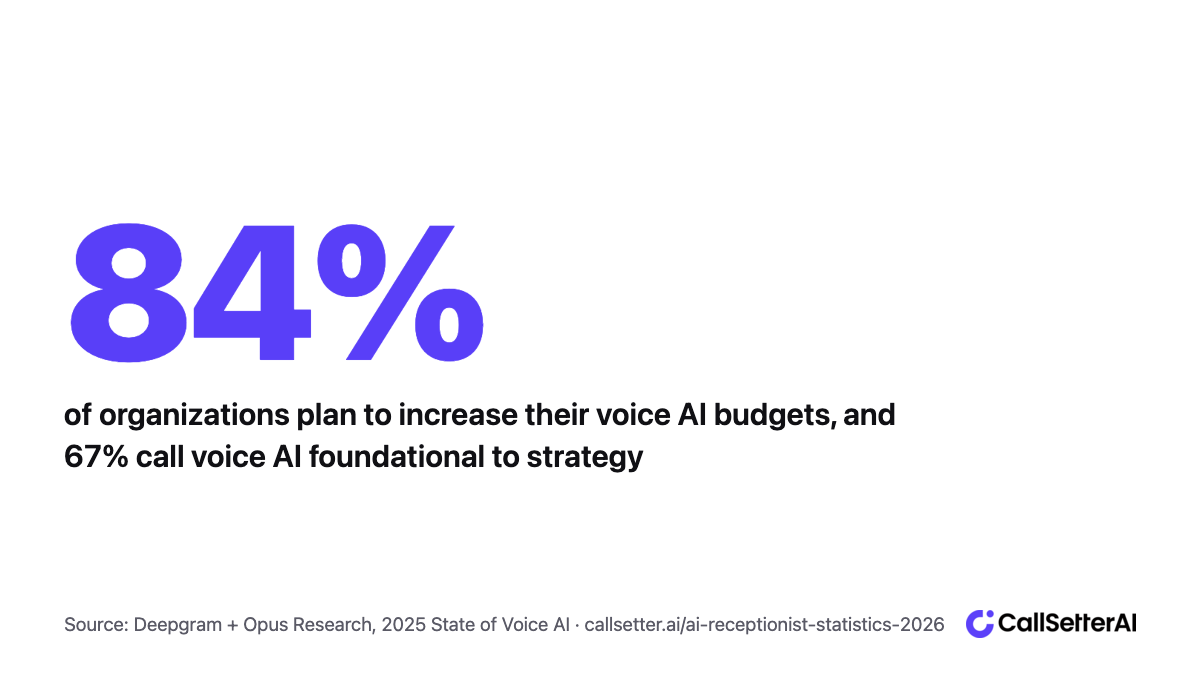
- 84% of organizations raising voice AI budgets: Deepgram + Opus Research, 2025 State of Voice AI. deepgram.com
- 21x qualification lift within 5 minutes: MIT lead response research, covered in our speed to lead breakdown.
- Worked examples (the HVAC $264,000 scenario, the ROI math in the FAQ, and the calculator above) are CallSetter AI arithmetic on stated inputs, shown step by step. They are estimates, not measurements.
How to Cite This Page
You are welcome to reference the numbers and charts on this page. Copy the citation below and link back to the canonical URL.