The missed call services market exists because most calls to small businesses are never answered. The average service business loses around $126,000 a year to unanswered calls, and the market that has grown up to fix it splits into three products: answering services staffed by people, self-serve AI you configure yourself, and done-for-you AI where somebody builds and runs the agent. They differ less on price than on who does the work and whether the call ends in a booking or a message.

The missed call services market is every product a business can buy so a ringing phone stops costing it money: human answering services, missed-call-text-back tools, and AI voice agents. This page maps the category for 2026: what drives demand, who buys, how the vendor types differ, and what each one costs. Every number here is tied to a named source, and the deeper per-industry math lives in our cost of missed calls breakdown.
Market Size and Growth Signals
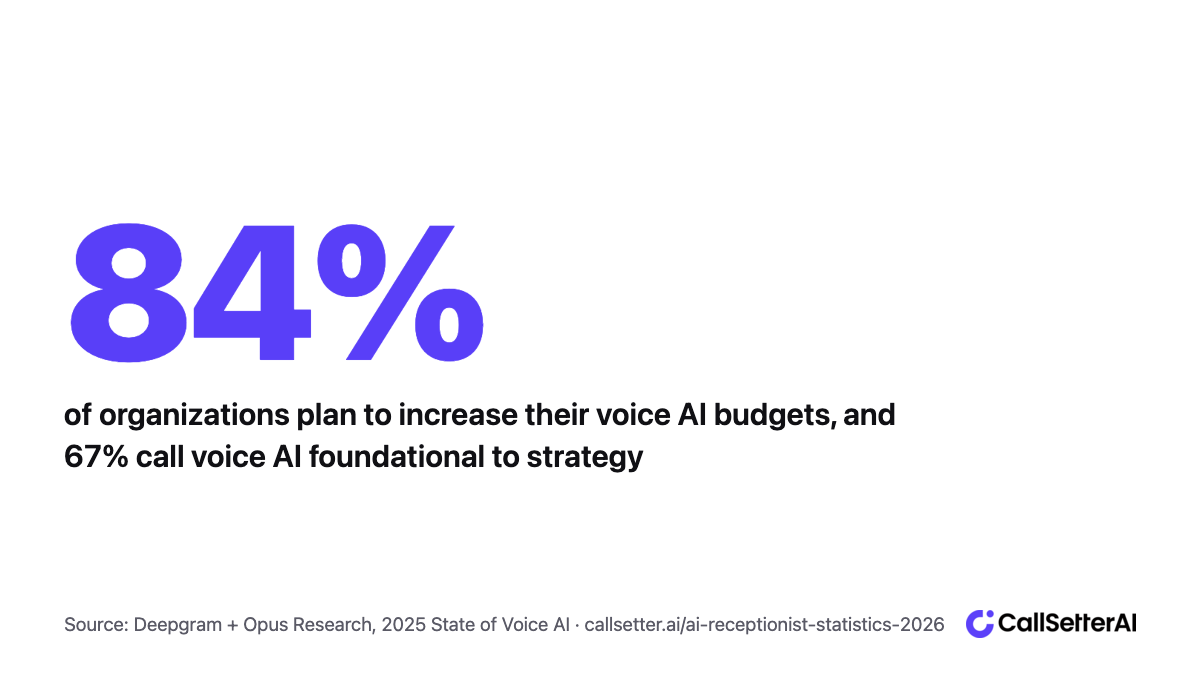
The missed call services market sells into phone calls that influence over $1 trillion in U.S. consumer spending a year, and Invoca puts the average service business at $126,000 a year in revenue lost to calls it never answered. Phone calls to businesses influence over $1 trillion in U.S. consumer spending a year, according to a 2019 analysis by BIA/Kelsey. That is the demand pool this category sells into. On the loss side, Invoca puts the average service business at $126,000 a year in revenue lost to missed calls, and Numa finds 22% of calls to small businesses go unanswered during operating hours. The clearest forward signal: 84% of organizations say they plan to raise voice AI budgets, per the Deepgram + Opus Research 2025 State of Voice AI report.
Who Buys Missed Call Services
The buyers are service businesses where one caller is worth hundreds to thousands of dollars and the phone is the booking channel. The per-industry stakes, each from the industry's own data source:
- HVAC: $300 to $500 average tickets, $1,500 to $5,000+ on installs, with 200 to 300% call spikes in seasonal peaks (ACHR News).
- Dental: $653 first-year patient value (ADA Health Policy Institute), $10,000 to $25,000 lifetime value (Levin Group).
- Legal: $3,000 to $50,000+ matters, $100,000+ on contingency (Clio Legal Trends).
- Plumbing and electrical: $350 to $500 service tickets, $750 to $2,500 bigger jobs (ServiceTitan).
- Real estate: $10,000 to $12,000 buyer-agent commissions (NAR), with lead conversion windows measured in minutes (Zillow research).
The Vendor Landscape: Three Product Types
Human answering services
Live operators answer with your greeting and take messages. Coverage is real, and after-hours matters: 35 to 45% of calls arrive outside business hours per Ruby. The ceiling is what an outside operator can do: most take messages rather than qualify, quote, or book.
Missed-call-text-back tools
Software that fires an automatic text when a call goes unanswered. Cheap and better than voicemail, but the lead still waits for a human callback, so the speed-to-lead advantage is already gone by the time someone follows up. A 2023 Clutch survey found the callback step is exactly where these leads stall. See our missed call text back guide.
AI voice agents
Software answers the call itself, qualifies the caller, and books the appointment in the moment. This is the segment growing fastest: it is the only type that answers instantly AND completes the booking, which is why voice AI budgets are rising across 84% of organizations (Deepgram + Opus Research).
Pricing Across the Market
Human answering services bill per call or per minute, so busy months cost more. Missed-call-text-back tools are usually a low flat software fee. AI appointment setting runs $29 to $500 a month flat depending on tier and volume; the full tier-by-tier math is in our AI appointment setting cost guide. Against Invoca's $126,000-a-year average loss, every option in the category prices as a rounding error, which is why the buying decision is about completion (does the call end in a booked job?) rather than cost.
Where the Market Is Going
Two forces shape 2026. First, caller patience keeps shrinking: 85% of callers who do not reach a business on the first attempt never call back (Numa). Second, budget intent has tipped toward AI (Deepgram + Opus Research). The market's center of gravity is moving from "take a message" to "finish the job on the first call." Vendors that only capture contact info are competing with vendors that complete the booking.
Methodology and Sources
- Every statistic on this page reuses a claim already published and sourced on our cost of missed calls analysis; source names link to the original publishers above.
- No market-size dollar figure is estimated by us; the $1 trillion figure is BIA/Kelsey's call-influenced spending analysis, not a category TAM.
- Pricing ranges reflect published plan pricing as compiled in our cost guide; individual vendors vary.
Frequently Asked Questions
What is the missed call services market?
It is the category of products businesses buy to stop losing revenue to unanswered phone calls: human answering services, missed-call-text-back software, and AI voice agents that answer, qualify, and book callers automatically.
How big is the missed call problem?
Phone calls influence over $1 trillion in U.S. consumer spending a year per BIA/Kelsey, 22% of calls to small businesses go unanswered during operating hours per Numa, and the average service business loses about $126,000 a year to missed calls per Invoca.
What are the three types of missed call services?
Human answering services (live operators who take messages), missed-call-text-back tools (automatic SMS after a missed call), and AI voice agents (software that answers the call, qualifies the caller, and books the appointment in the moment).
Which type of missed call service should a small business pick?
Match the tool to the job the call does. If callers just need a message taken, an answering service works. If your revenue depends on booked appointments, only an AI voice agent both answers instantly and completes the booking; text-back tools still leave the lead waiting for a callback.
How to Cite This Page
You are welcome to reference this market overview. Copy the citation below and link back to the canonical URL.