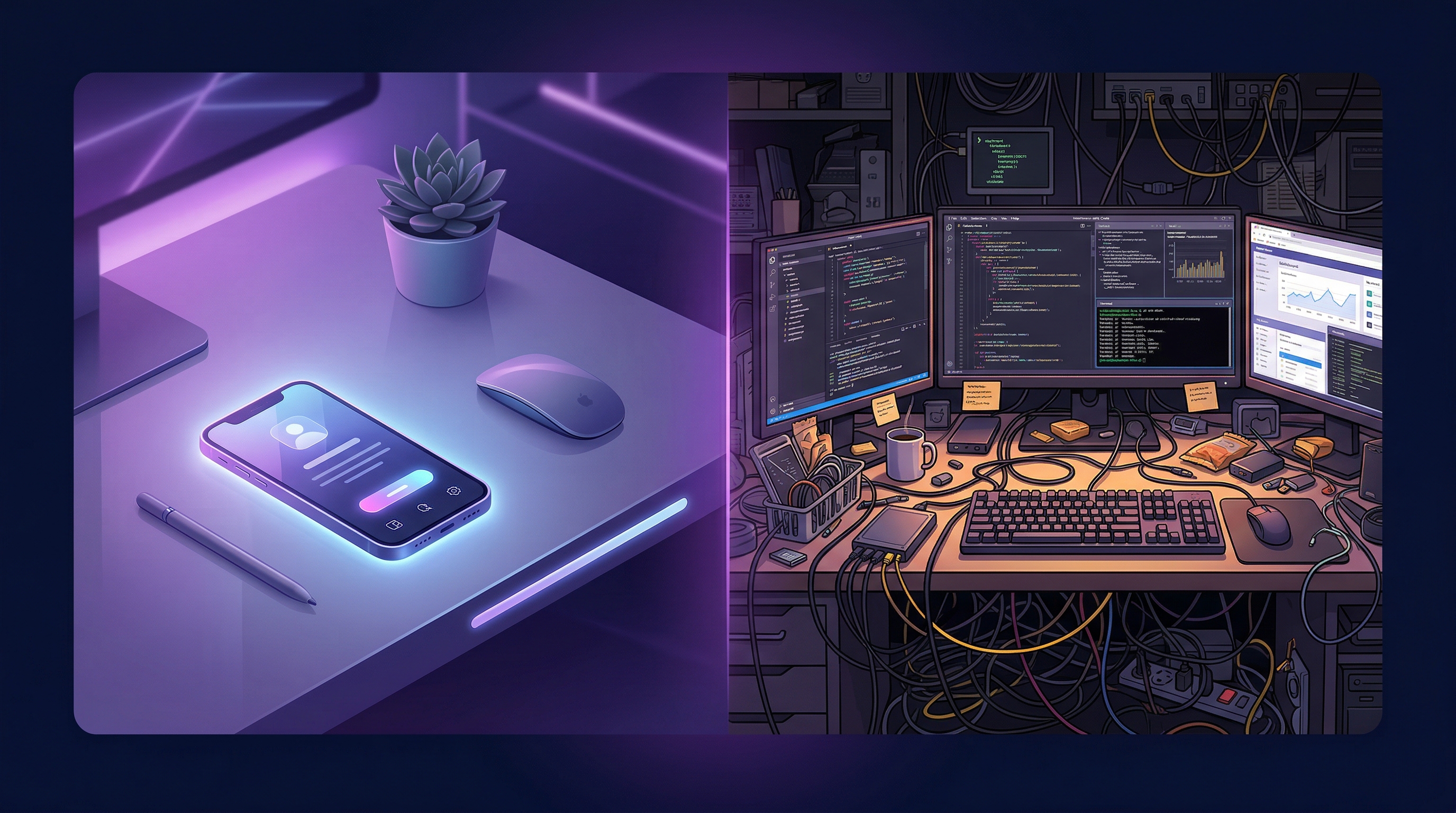
The AI calling agent market is projected to reach $47.5 billion by 2034, growing at a 16.3% compound annual growth rate according to Grand View Research. That growth has created two distinct paths for businesses: build it yourself on a developer platform, or hire a service that handles everything for you. Both can work. But they serve very different businesses, at very different price points, with very different levels of effort required.
Done for you AI voice agent services hand you a working agent, while DIY platforms hand you the parts: 80 to 200 hours of developer time at $75 to $200 per hour to build the first one. This guide breaks down the real differences between DIY AI voice agent platforms (Retell AI, Vapi, Synthflow vs Retell vs Vapi, Bland AI) and done-for-you services (CallSetter AI and similar managed providers). No marketing spin. Just data on setup time, costs, technical requirements, and outcomes.
The DIY Path: What It Actually Takes
DIY platforms give you the building blocks. Retell AI, Vapi, Synthflow, and Bland AI each provide APIs for text-to-speech, speech-to-text, large language model orchestration, and telephony integration. You assemble these components into a working voice agent. Think of it like buying lumber and tools versus hiring a contractor to build your deck.
Technical Requirements
Building on a DIY platform requires someone who can write and maintain production code. At minimum, you need proficiency in prompt engineering, API integration, webhook configuration, and error handling. Most platforms use JavaScript or Python SDKs, so a developer comfortable with either language is essential.
Beyond the initial build, you need someone who understands conversation design. An AI voice agent is not a chatbot with audio. It requires carefully structured conversation flows, interruption handling, silence detection tuning, and edge case management. According to Rasa's 2024 Conversational AI Report, the average enterprise chatbot requires 47 distinct conversation flows to handle 80% of real-world interactions.
Platform-by-Platform Comparison
| Feature | Retell AI | Vapi | Synthflow | Bland AI |
|---|---|---|---|---|
| Pricing model | Per minute | Per minute | Monthly plans | Per minute |
| Per-minute cost | $0.07-0.25 | $0.05-0.15 | Included in plan | $0.09-0.12 |
| LLM flexibility | OpenAI, custom | Any LLM | OpenAI | OpenAI, custom |
| Calendar integration | API/webhook | API/webhook | Built-in | API/webhook |
| No-code option | Limited | No | Yes | No |
| Coding required | Yes | Yes | Minimal | Yes |
| Latency (avg) | 800-1200ms | 600-1000ms | 1000-1500ms | 700-1100ms |
The Hidden Costs of DIY
Platform pricing looks cheap on paper. $0.07 per minute sounds reasonable until you factor in the full cost stack. Developer time to build the initial agent: 80 to 200 hours at $75 to $200 per hour. That is $6,000 to $40,000 before the agent makes its first call. Then add ongoing costs: prompt iteration (the first version is never production-ready), bug fixes when the agent mishandles edge cases, LLM API costs (OpenAI GPT-4 runs $0.03 to $0.06 per 1K tokens), telephony costs, and monitoring.
According to a 2025 survey by AI Infrastructure Alliance, companies that chose DIY AI implementations spent an average of 3.2x their initial budget estimate before reaching production quality. The most common reason: underestimating the iteration cycles needed to handle real caller behavior.
The platform cost is 10% of the total cost. The other 90% is the developer time to build, test, iterate, and maintain the agent in production. Most businesses underestimate this by 3x or more.
The Done-for-You Path: What You Get
Done-for-you services handle the entire stack. You describe your business, your services, your qualifying questions, and your calendar. The provider builds the agent, tests it, deploys it, and maintains it. Your involvement is a few onboarding calls and ongoing feedback on call quality.
What a Managed Service Includes
- Conversation design: Professional prompt engineering based on thousands of real calls, not templates
- Calendar integration: Direct sync with Google Calendar, Calendly, ServiceTitan, Housecall Pro, or whatever scheduling system you use
- CRM integration: Lead data flows automatically into your existing pipeline
- Phone number provisioning: Dedicated local or toll-free numbers configured and tested
- Ongoing optimization: Call recordings reviewed, prompts refined, edge cases handled as they surface
- Compliance: TCPA-compliant call handling, proper disclosures, opt-out mechanisms
- 24/7 availability: No server monitoring on your end. The provider handles uptime.
Cost Structure
Done-for-you services typically charge a flat monthly fee plus per-call or per-appointment pricing. For CallSetter AI, businesses pay a predictable monthly rate that covers the agent build, hosting, optimization, and support. Compare that to the DIY model where you are paying platform fees, LLM API costs, developer salaries, and telephony separately, with no ceiling on what iteration will cost.
Head-to-Head: The Real Differences
| Factor | DIY Platform | Done for You |
|---|---|---|
| Time to first call | 4-14 weeks | 3-5 business days |
| Technical skill needed | Developer required | None |
| Upfront cost | $6,000-$40,000+ | $997-$1,997 setup fee |
| Monthly cost | $1,500-$5,000+ (all-in) | $497-$1,997/mo |
| Ongoing maintenance | You handle it | Provider handles it |
| Conversation quality | Depends on your prompts | Battle-tested scripts |
| Customization ceiling | Unlimited | High (within framework) |
| Calendar integration | Build it yourself | Included |
| Compliance handling | Your responsibility | Built-in |
| Scaling | Add infrastructure | Automatic |
When DIY Makes Sense
The DIY path is the right choice in specific scenarios. If your business has an in-house development team with AI experience, building your own agent gives you maximum control over every aspect of the conversation. SaaS companies that want to embed voice AI into their own product need the flexibility of a platform like Retell or Vapi. Enterprises with unique compliance requirements (healthcare with HIPAA, financial services with SEC regulations) may need the granular control that DIY provides.
DIY also makes sense if voice AI is your core product, not a tool you are adding to your business. If you are building a company around AI calling, you need to own the technology stack.
The DIY Checklist
Before choosing DIY, confirm you have all of the following:
- A developer (in-house or contracted) with 6+ months of availability
- Budget for 3-6 months of iteration before production quality
- Someone to monitor calls daily and refine prompts weekly
- Tolerance for the agent making mistakes during the learning period
- Infrastructure for logging, monitoring, and alerting on agent failures
When Done-for-You Makes Sense
For service businesses (HVAC, plumbing, dental, legal, solar), a done-for-you service is almost always the better path. Your core business is delivering services, not building AI technology. The speed advantage alone is worth it. While a DIY project burns 14 weeks in development, a done-for-you agent is answering calls in under a week. Every week of delay means missed leads.
Consider the math for a plumbing company that misses 30 calls per month. At an average ticket of $400 (HomeAdvisor 2025 data), that is $12,000 per month in lost revenue. A done-for-you service that costs $497 per month and captures even half of those missed calls generates $5,600 per month in recovered revenue. The ROI is immediate.
Skip the 14-Week Build. Go Live This Week.
CallSetter AI handles everything: conversation design, calendar integration, phone setup, and ongoing optimization. No developers needed. No code to maintain.
Book a DemoThe Hybrid Approach
Some businesses start with a done-for-you service to capture immediate value, then evaluate whether migrating to a DIY platform makes sense after 6 to 12 months. This approach eliminates the opportunity cost of the build phase while giving you real call data to inform a future custom build. You learn exactly what conversation flows matter, what edge cases arise, and what integrations you need, before investing in development.
The data from a managed service also gives you a benchmark. If you build a custom agent later, you know exactly what performance level it needs to match. Without that benchmark, you are optimizing blind.
Making the Decision
Strip away the marketing and the decision comes down to three questions. First, do you have a developer who can dedicate 3+ months to this project? Second, is voice AI your core product or a tool to support your business? Third, can your business afford 14 weeks of missed calls while the agent is being built?
If the answer to all three is yes, DIY platforms offer powerful flexibility. If any answer is no, a done-for-you service gets you to the same outcome faster, cheaper, and with less risk. The technology behind both approaches is fundamentally the same. The difference is who does the work.