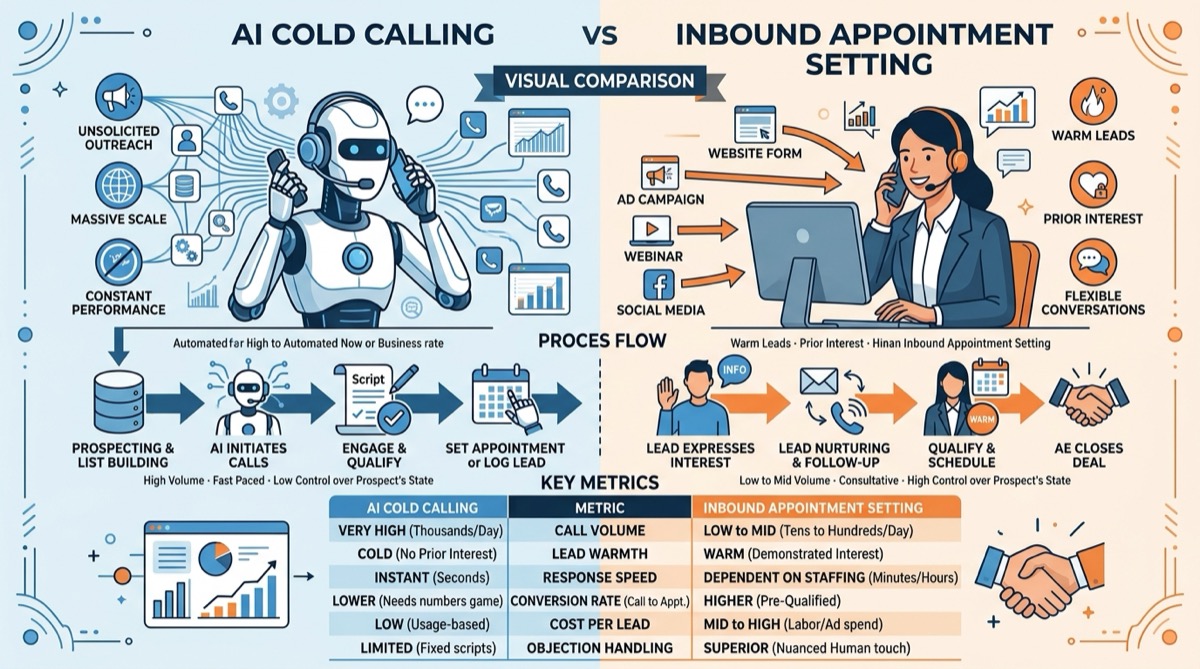
The phrase "AI calling" has become a catch all term that lumps together two fundamentally different strategies. On one side, you have AI cold calling: autonomous agents dialing through purchased contact lists, interrupting strangers during dinner, and hoping to generate interest where none previously existed. On the other side, you have AI inbound appointment setting: intelligent agents that answer calls and respond to leads from people who have already expressed interest in your services.
AI cold calling and AI inbound appointment setting sit at opposite ends of the sales process: cold dials convert at about 2.3%, while inbound booking closes the appointment on the call itself in 90 seconds to 4 minutes. These are not variations of the same approach. They are opposite ends of the sales spectrum, and the difference in outcomes is massive. If you are evaluating AI voice technology for your business, understanding this distinction will save you months of wasted effort and tens of thousands of dollars in misallocated budget.
What AI Cold Calling Actually Looks Like
AI cold calling tools use voice synthesis and language models to make outbound calls to lists of people who have never interacted with your business. The AI dials a number, delivers a scripted pitch, attempts to handle objections, and tries to transfer "interested" prospects to a human closer or book a meeting.
On paper, the value proposition is straightforward: replace expensive SDRs with tireless AI agents that can make 1,000 calls per day at a fraction of the cost. In practice, the economics and outcomes tell a very different story.
The Compliance Minefield
The FTC and state regulators have made their position unambiguous. The legal landscape around AI cold calling is tightening rapidly. The FTC's 2024 ruling explicitly prohibits AI generated voices in unsolicited calls without prior consent. The TCPA imposes penalties of $500 to $1,500 per violation. Multiple states have introduced additional restrictions, and class action lawsuits against companies using AI for cold calls are accelerating.
This is not a hypothetical risk. Companies have already faced seven and eight figure settlements for violating telemarketing regulations with automated calling technology. Every AI cold call made without explicit prior consent exposes your business to regulatory action.
The Performance Reality
Cold calling, whether human or AI, operates against fundamental buyer psychology. The person receiving the call did not ask for it, did not expect it, and in most cases does not want it. Studies from Rain Group show that 82% of buyers accept meetings with sellers who reach out, but only when the outreach is relevant and well timed. A robotic voice interrupting lunch to pitch a service you have never searched for does not meet that threshold.
Real world data from companies running AI cold calling campaigns shows connect rates between 5% and 12% (most people do not answer unknown numbers), conversation rates between 15% and 25% of those who answer (the rest hang up immediately), and appointment conversion rates of 1% to 3% of total dials. The math means you need roughly 500 to 1,000 AI cold calls to generate a single qualified appointment.
What AI Inbound Appointment Setting Actually Looks Like
AI inbound appointment setting flips the entire model. Instead of calling strangers, the AI answers calls and messages from people who are already looking for your services. These are leads who searched Google, clicked your ad, filled out your form, called your business number, or responded to a marketing campaign. Their intent is already established.
When a potential customer calls your business at 8 PM on a Tuesday, the AI answers instantly. It greets them by name if caller ID is available. It asks about their needs using a natural, conversational flow. It qualifies them against your criteria (location, budget, timeline, service type). It checks your calendar in real time. It books the appointment on the spot. The entire interaction takes 90 seconds to 4 minutes, and the customer hangs up with a confirmed appointment.
No callbacks required. No voicemail tag. No lead decay while your team sleeps.
The fundamental difference is intent. Cold calling creates interruptions for people who did not ask for them. Inbound appointment setting serves people who are actively trying to reach your business. One fights buyer psychology. The other aligns with it.
Head to Head Comparison
| Factor | AI Cold Calling | AI Inbound Setting |
|---|---|---|
| Lead intent | Zero. Contact has no prior interest. | High. Lead initiated contact. |
| Conversion rate | 1% to 3% of total dials | 25% to 35% of answered leads |
| Cost per appointment | $200 to $500+ | $12 to $35 |
| Legal risk | High. FTC, TCPA, state regulations. | Minimal. Responding to inbound inquiries. |
| Brand perception | Negative. Associated with spam. | Positive. Fast, professional response. |
| Customer experience | Intrusive. Unwanted interruption. | Welcomed. Instant help when needed. |
| Data requirements | Purchased lists. Accuracy varies. | Your existing lead flow. No list buying. |
| Scalability | Linear. More calls = more cost + risk. | Elastic. Handles volume spikes instantly. |
| ROI timeline | 3 to 6 months to optimize | Positive ROI within 30 days |
Why Inbound AI Converts 10x Higher
The conversion gap is not a mystery. It is behavioral economics. When someone calls your business or submits a lead form, they have already completed the most difficult stages of the buying journey: problem recognition, information search, and initial evaluation. They know they need a service. They found your business. They took the action to reach out. The only remaining step is the transaction.
As speed to lead research from MIT confirms, leads contacted within 60 seconds are 391% more likely to convert than leads contacted at 30 minutes. AI inbound agents operate in that 60 second window automatically. Every time. No lunch breaks, no after hours gaps, no Monday morning queue backlog.
The "Lead Reactivation" Advantage
One of the most overlooked applications of AI inbound technology is reactivating dormant leads. Every business has a database of past inquiries that went cold: people who called but never booked, form submissions that were never followed up on, past customers who have not returned. These are not cold leads in the traditional sense. They are warm leads that went cold due to slow response times or dropped follow up.
AI agents can systematically work through these databases, reaching out to people who previously expressed interest. Because there is prior intent (they contacted you first at some point), these reactivation campaigns see conversion rates 3x to 5x higher than pure cold outreach. The AI references the previous interaction, offers updated availability, and books the appointment. No purchased lists. No compliance risk. Just revenue recovery from leads you already paid to acquire.
Stop Chasing. Start Converting.
CallSetter AI answers every inbound lead in under 60 seconds, qualifies them, and books the appointment. No cold calling. No compliance risk. Just more booked appointments from the leads you already have.
Book a DemoThe Economics: Cold Calling vs Inbound
Let us run the numbers for a mid size HVAC company receiving 200 inbound leads per month with an average ticket of $450.
Scenario A: Invest in AI Cold Calling
Platform cost: $500 to $2,000 per month. List acquisition: $200 to $800 per month for quality data. Per minute charges for AI calls: $0.08 to $0.15 per minute. At 5,000 dials per month with 3 minutes average connected call time, that is $1,200 to $2,250 in usage fees alone. Total monthly cost: $1,900 to $5,050. Expected appointments at 2% conversion of total dials: 100 appointments. But wait. These are cold leads with no established intent, so the show rate drops to 40% to 55%, and the close rate drops to 15% to 25% of those who show. Net new customers per month: 6 to 14. Revenue: $2,700 to $6,300. Barely break even, if you are lucky.
Scenario B: Deploy AI Inbound Appointment Setting
Platform cost: $300 to $1,000 per month. No list acquisition (your leads are already calling). Per minute charges: $0.08 to $0.12 per minute. At 200 inbound leads with 4 minutes average call: $64 to $96 in usage. Total monthly cost: $364 to $1,096. Expected appointments at 28% conversion: 56 booked. Show rate for inbound appointments: 75% to 85%. Close rate: 55% to 70%. Net new customers per month: 23 to 33. Revenue: $10,350 to $14,850. ROI: 850% to 1,250%.
When Cold Calling Makes Sense (And When It Does Not)
This article is not arguing that outbound sales is dead. Outbound prospecting, done correctly through personalized email sequences, LinkedIn outreach, and strategic networking, remains a viable growth channel for B2B companies with long sales cycles and high contract values.
What does not work is using AI to automate the lowest value, highest risk form of outbound: unsolicited phone calls to purchased lists. The economics are unfavorable, the legal exposure is significant, and the brand damage is real. One negative review mentioning "spam robot calls from [your company]" costs more to repair than the appointments the campaign generated.
Where Inbound AI Delivers the Most Impact
- Home services: Plumbing, HVAC, roofing, electrical, solar. High call volume, time sensitive needs, after hours demand.
- Healthcare: Dental practices, med spas, chiropractic offices. Patient scheduling, intake qualification, no show follow up.
- Professional services: Law firms, insurance agencies, real estate. Client intake, consultation booking, after hours availability.
- Any business running ads: If you are spending money on Google Ads, Facebook Ads, or LSA to drive calls and form fills, every missed or delayed response is burning your ad spend.
The Future: AI as Your Best Employee, Not Your Worst Telemarketer
The trajectory of AI in sales is clear. The companies generating the highest returns are not using AI to do more of what already annoys buyers. They are using AI to do more of what buyers actually want: instant responses, intelligent conversations, and frictionless scheduling.
The best AI voice agents in 2026 are indistinguishable from well trained human receptionists during a 3 to 5 minute call. They understand context. They handle objections naturally. They remember caller preferences. They operate with the same professionalism your best employee does, but they never call in sick, never take vacation, and never let a lead go to voicemail.
That is the difference between AI cold calling and AI inbound appointment setting. One uses the technology to scale interruptions. The other uses it to deliver exceptional customer experiences at the exact moment people are trying to give you their business.
Every dollar you spend on AI cold calling would generate 5x to 10x more revenue if redirected toward capturing and converting the inbound leads you are already losing to voicemail, slow response times, and after hours gaps.
How CallSetter AI Approaches This Problem
CallSetter AI is built exclusively for inbound lead capture and appointment setting. We do not offer cold calling features because the data does not support it and the legal trajectory is moving against it. Our entire platform is designed around one outcome: making sure every person who tries to reach your business gets an instant, professional response that ends with a booked appointment.
The system answers calls in under 60 seconds. It qualifies leads based on your specific criteria. It checks your team's real time availability. It books the appointment and sends confirmations. It follows up with no shows to rebook. It works 24/7/365 without capacity constraints. Learn more about how it works or see pricing for your industry.
If you are currently losing leads to voicemail, slow callbacks, or after hours gaps, that is where the immediate revenue opportunity lives. Not in calling strangers. In serving the people who are already calling you.