Dental appointment no-shows cost the average practice $150,000 per year. For med spas, the number is even higher because procedure values range from $300 to $5,000 per appointment. The industry standard no-show rate sits between 15% and 23% for dental practices and 18% to 28% for med spas. Every empty chair is lost revenue that cannot be recovered, and the time slot that was held open for that patient cannot be reallocated retroactively.
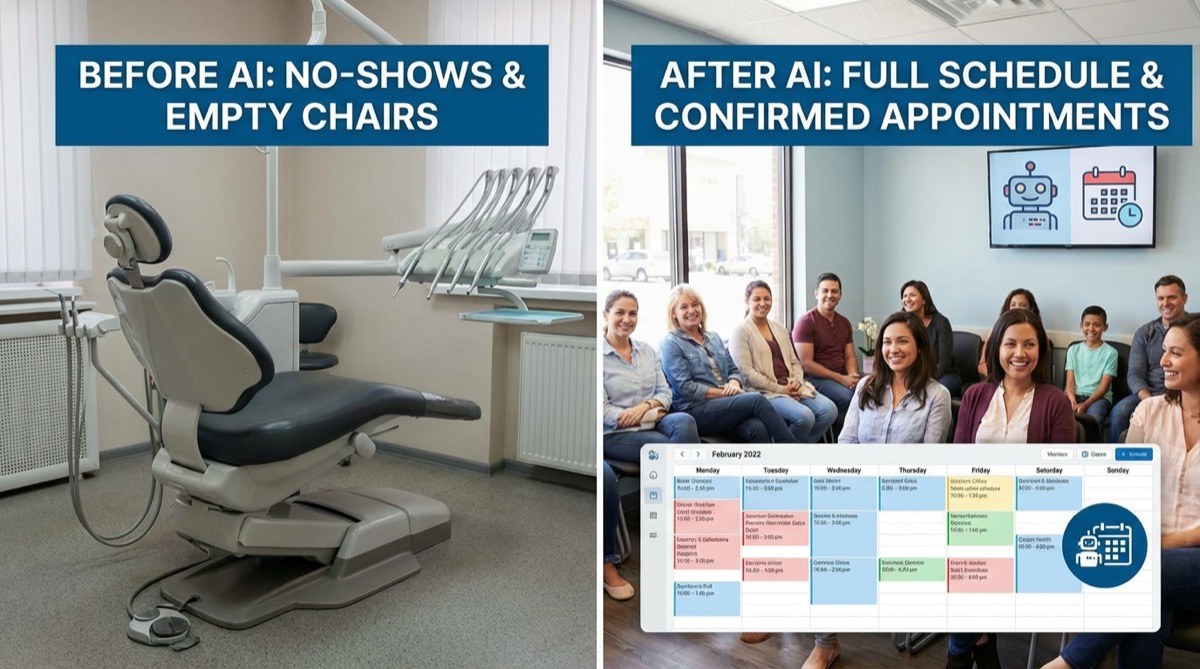
AI cuts dental appointment no shows by a median of 34% by booking the patient during the first call and running reminders across the whole appointment lifecycle. AI appointment setting attacks the no-show problem at its root causes: delayed booking (which weakens commitment), lack of personalized reminders, and friction in the rescheduling process. Practices using AI for the full appointment lifecycle (from initial booking through confirmation and follow up) see no-show rates drop by 28% to 40%, with the median improvement at 34%.
Why Patients No-Show: The Three Root Causes
Understanding why patients miss appointments is essential to fixing the problem. No-shows are not random. They follow predictable patterns driven by three factors, and each can be addressed systematically.
Root Cause 1: The Booking Gap
The longer the gap between when a patient decides they need an appointment and when the appointment is actually booked, the higher the no-show probability. A patient who calls a dental practice, gets voicemail, and receives a callback 4 hours later has already moved on psychologically. Even if they book during the callback, their commitment level is lower than someone who booked in the moment of intent. Research from the Journal of Dental Education shows that patients who book appointments during the initial call have a 14% higher show rate than those who book via callback.
AI appointment setting eliminates the booking gap entirely. When a patient calls, the AI answers immediately, qualifies them (new patient vs existing, insurance verification, service type), and books the appointment in real time. The patient hangs up with a confirmed slot, a text confirmation, and calendar invite. The intent-to-booking window is measured in seconds, not hours.
Root Cause 2: Reminder Failure
Most practices send one or two reminders (a text the day before, sometimes a call 72 hours out). This is better than nothing but misses the optimal reminder cadence. Research from medical scheduling studies shows that the most effective reminder sequence is: confirmation text immediately after booking, a reminder 72 hours before the appointment, a second reminder 24 hours before, and a final "see you today" message 2 hours before. Practices that use this four touch sequence see 22% fewer no-shows than those using single reminders.
AI systems automate the full reminder sequence without any manual effort from your front desk. Each message is personalized with the patient's name, appointment type, provider name, and office address. If the patient responds to a reminder asking to reschedule, the AI handles the rescheduling conversation automatically.
Root Cause 3: Rescheduling Friction
Many patients who no-show would have rescheduled if the process were easier. Calling during business hours, waiting on hold, and navigating a receptionist's schedule is enough friction that patients simply do not show up and do not call to cancel. In a survey by PatientPop, 42% of patients who no-showed said they would have rescheduled if they could have done so via text or automated phone system outside of business hours.
AI appointment agents make rescheduling as easy as replying "reschedule" to a reminder text. The AI responds instantly with available time slots, and the patient confirms a new time without ever speaking to a human. This converts would-be no-shows into rescheduled visits, preserving both the revenue and the patient relationship.
The practices with the lowest no-show rates are not the ones with the best patients. They are the ones with the least friction between intent and action. AI removes every friction point in the booking, reminder, and rescheduling process.
Dental Practices: The No-Show Math
Consider a dental practice with 400 appointments per month and a 20% no-show rate. That is 80 empty slots per month. At an average appointment value of $275, the monthly revenue loss is $22,000 or $264,000 per year.
With AI appointment setting reducing no-shows by 34%, the practice recovers 27 of those 80 appointments per month. That is $7,425 per month in recovered revenue, or $89,100 per year. Against a monthly AI service cost of $500 to $1,000, the ROI is 620% to 1,485%.
The compound effect is even larger. Each recovered new patient appointment represents $10,000 to $25,000 in lifetime value. If just 10 of the 27 recovered monthly appointments are new patients, the lifetime value recovery is $100,000 to $250,000 per month in long term patient value.
Dental Specific AI Capabilities
- Insurance pre-qualification: The AI asks about insurance during booking and can verify coverage against common dental plans before confirming the appointment, reducing day-of cancellations due to insurance issues.
- Treatment follow up: For patients who need follow up procedures (crowns after root canals, implant placements after bone grafts), the AI proactively calls to schedule the next appointment, reducing the 40% drop off rate that occurs when patients are told to "call when you are ready."
- Hygiene recall: Automated 6 month recall campaigns that call patients due for cleanings, book appointments during the conversation, and fill cancellation slots from a waitlist.
Med Spas: High Ticket, High No-Show Impact
Med spas face an even more severe no-show impact because appointment values are significantly higher. A Botox appointment averages $400 to $600. A laser treatment averages $800 to $2,500. A body contouring session averages $1,500 to $4,000. With industry no-show rates of 18% to 28%, the revenue impact is staggering.
For a med spa booking 200 appointments per month at an average value of $750 with a 22% no-show rate, the math is: 44 no-shows per month times $750 equals $33,000 in monthly lost revenue, or $396,000 per year. A 34% reduction in no-shows recovers 15 of those appointments, adding $11,250 per month or $135,000 per year back to the top line.
Med Spa Specific AI Capabilities
- Pre-treatment instructions: The AI includes treatment specific preparation instructions in reminder messages (no sun exposure, avoid blood thinners, arrive with clean skin), which reduces day-of cancellations caused by patients arriving unprepared.
- Package upsell on rebook: When a patient calls to book their next session in a package series, the AI can offer upgraded packages or add on treatments based on their history.
- Deposit collection: For high value procedures, the AI can collect a deposit during booking via text-to-pay, increasing commitment and reducing no-shows by an additional 18% to 25%.
Reduce No-Shows Starting This Week
CallSetter AI handles booking, reminders, rescheduling, and no-show follow up automatically. Dental practices and med spas see a 34% no-show reduction within the first 30 days.
Book a DemoThe No-Show Follow Up Sequence That Recovers Revenue
When a patient does no-show despite all prevention efforts, the AI does not let the opportunity die. Within 15 minutes of the missed appointment time, the AI sends a text: "We missed you at your [appointment type] today. Would you like to reschedule? Reply with YES and we will find a time that works." For patients who do not respond to the text, the AI makes a follow up call the next morning.
This automated follow up sequence recovers an additional 15% to 22% of no-shows as rescheduled appointments. Without automation, most practices never follow up on no-shows at all because the front desk is already overwhelmed with the day's scheduled patients. The revenue just evaporates. Our detailed guide on AI no-show follow up covers the full sequence and recovery rates.
Implementation Timeline
Setting up AI appointment setting for a dental practice or med spa follows a standard timeline. Day 1: Connect your practice management system (Dentrix, Eaglesoft, Open Dental, Aesthetic Record, or your current PMS). Day 2: Configure the booking workflow, reminder sequence, and no-show follow up rules. Day 3: Test with staff calls, adjust the conversation flow. Day 4 and beyond: Live with patients.
Most practices see measurable no-show improvement within the first 2 weeks as the automated reminder sequence takes effect. The full 34% improvement typically materializes within 30 to 45 days as the system builds a history of patient interactions and the rescheduling automation captures would-be no-shows.
See how CallSetter AI works or book a demo to see the no-show reduction system in action for your practice.
No-shows are not a patient behavior problem. They are a systems problem. Fix the system and the behavior follows. AI appointment setting fixes every gap in the patient journey from first call to confirmed attendance.